
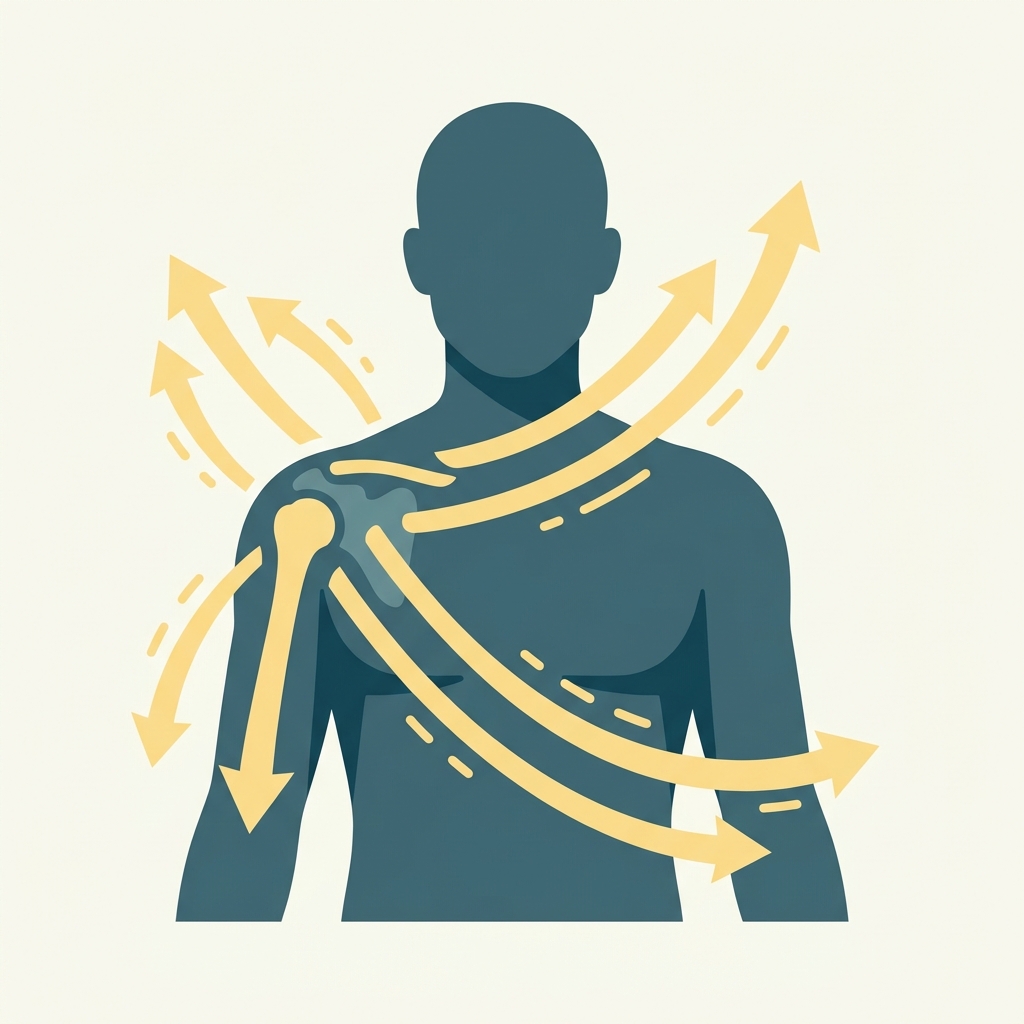
PNF Diagonal Patterns (D1/D2) Exercises
Step-by-step home exercise guide for Proprioceptive Neuromuscular Facilitation (PNF) diagonal patterns (D1/D2) to enhance shoulder neuromuscular control and joint position sense.
Proprioceptive Neuromuscular Facilitation (PNF) diagonal patterns are a set of specialized exercises used in physical therapy to enhance joint position sense, coordination, and strength in the shoulder. These patterns mimic natural diagonal and rotational movements of daily living, such as reaching for a seatbelt or brushing your hair. By moving the shoulder through these three-dimensional patterns, you train the brain and muscles to work together efficiently, improving overall neuromuscular control and joint stability.
These exercises are highly effective for individuals recovering from shoulder instability, tendonitis, or surgery once they are cleared for active range of motion. Performing them regularly helps rebuild the shoulder's natural reflexes and dynamic control.
General Guidelines & Safety Precautions
Before beginning, please review these safety guidelines to ensure a safe and effective exercise session:
- Warm-Up: Start with 2 to 3 minutes of gentle shoulder movements, such as shoulder shrugs, circles, or arm swings, to increase blood flow to the joint.
- Pain Rule: These exercises should be challenging but never painful. If you feel a sharp or sudden pain, stop the exercise immediately. A dull ache or mild muscle fatigue is normal.
- Control: Focus on slow, deliberate movements rather than speed. Concentrating on the quality of movement maximizes neuromuscular activation.
- Posture: Maintain a tall, upright posture with your chest up and shoulders pulled back throughout the patterns.
Exercise 1: PNF D1 Flexion (The \"Opposite Ear Reach\")
Purpose: Restores functional reaching across the body, activating the front shoulder (anterior deltoid), chest (pectorals), and shoulder blade stabilizers.
Equipment Needed: None (active range of motion) or a very light resistance band.
Starting Position: Stand tall. Extend your active arm down and out at your side (away from your hip). Rotate your arm so your palm faces backward and your thumb points toward the floor.
Step-by-Step Instructions:
- Slowly bring your hand up and across your body toward your opposite ear.
- As your hand moves up and across, rotate your arm so that your palm faces toward your face and your thumb points backward at the top.
- Keep your eyes on your hand throughout the motion to help coordinate the movement.
- Pause for 1 second at the top, then slowly reverse the pattern back to the starting position.
Dosage: Perform 2 sets of 10 repetitions, once or twice daily.
Tips/Common Mistakes to Avoid: Keep your shoulders relaxed. Do not shrug your shoulder toward your ear as you reach up. Keep the movement smooth and continuous.
Exercise 2: PNF D1 Extension (The \"Pocket Reach\")
Purpose: Strengthens the muscles that pull the arm down and back, including the latissimus dorsi, triceps, and lower shoulder blade stabilizers, promoting controlled deceleration.
Equipment Needed: None or a light resistance band anchored high.
Starting Position: Begin with your hand near your opposite ear. Your palm should face your ear, with your thumb pointing downward.
Step-by-Step Instructions:
- Push your hand down and diagonally away from your body, ending with your arm extended down and slightly behind your hip on the same side.
- As your arm moves down and out, rotate your forearm so your palm faces backward and your thumb points toward the floor.
- Focus on squeezing your shoulder blade down and back as you finish the movement.
- Slowly return to the starting position near your opposite ear with control.
Dosage: Perform 2 sets of 10 repetitions, once or twice daily.
Tips/Common Mistakes to Avoid: Avoid bending at the waist. Keep your torso still and let the movement come entirely from your shoulder and shoulder blade.
Exercise 3: PNF D2 Flexion (The \"Draw the Sword\")
Purpose: Improves overhead reaching and external rotation. This activates the rotator cuff (supraspinatus and infraspinatus) and the upper back muscles (trapezius and serratus anterior) responsible for upwardly rotating the shoulder blade.
Equipment Needed: None or a light resistance band anchored low near your opposite foot.
Starting Position: Stand tall. Rest your active hand near your opposite hip (as if grasping the handle of a shoulder sword in its scabbard). Your palm should face your hip, and your thumb should point down and inward.
Step-by-Step Instructions:
- Lead with your thumb, pulling your hand up and out diagonally away from your body.
- As your hand rises, rotate your arm outward so that your palm faces forward and outward, and your thumb points backward at the top.
- Follow your hand with your eyes to build coordination between your neck, spine, and shoulder.
- Pause briefly, then control the movement as you lower your hand back to your opposite hip.
Dosage: Perform 2 sets of 10 repetitions, once or twice daily.
Tips/Common Mistakes to Avoid: Keep your elbow straight but not locked. Avoid arching your lower back to reach higher; only go as high as your shoulder flexibility comfortably allows.
Exercise 4: PNF D2 Extension (The \"Sheathe the Sword\")
Purpose: Strengthens the muscles that bring the arm down and across, simulating functional reaching and lifting tasks, while training the internal rotators and chest muscles.
Equipment Needed: None or a light resistance band anchored high and to the side.
Starting Position: Start with your arm raised high and out to the side (abducted and externally rotated), palm facing forward/outward, and thumb pointing backward.
Step-by-Step Instructions:
- Move your arm down and diagonally across your body toward your opposite hip.
- As your arm descends, rotate it inward so your palm faces your opposite hip and your thumb points downward.
- Control the deceleration at the bottom of the movement.
- Return slowly and smoothly back to the high-and-out starting position.
Dosage: Perform 2 sets of 10 repetitions, once or twice daily.
Tips/Common Mistakes to Avoid: Avoid rounding your upper back or letting your shoulder roll forward excessively at the bottom of the movement. Keep your chest broad.
Always consult with your physical therapist or doctor before starting a new exercise routine. If any exercise causes persistent pain or swelling, discontinue it and contact your healthcare provider.
Disclaimer: This guide provides general exercise instructions and is not a substitute for professional medical advice. Always consult your doctor or qualified healthcare provider with any questions you may have regarding your specific medical condition and treatment plan.

Related articles
Browse all articlesTrusted External Resources
Curated educational materials to help you make informed decisions about your orthopaedic bone & joint conditions.

Orthopaedia

Orthogate Patient Education