
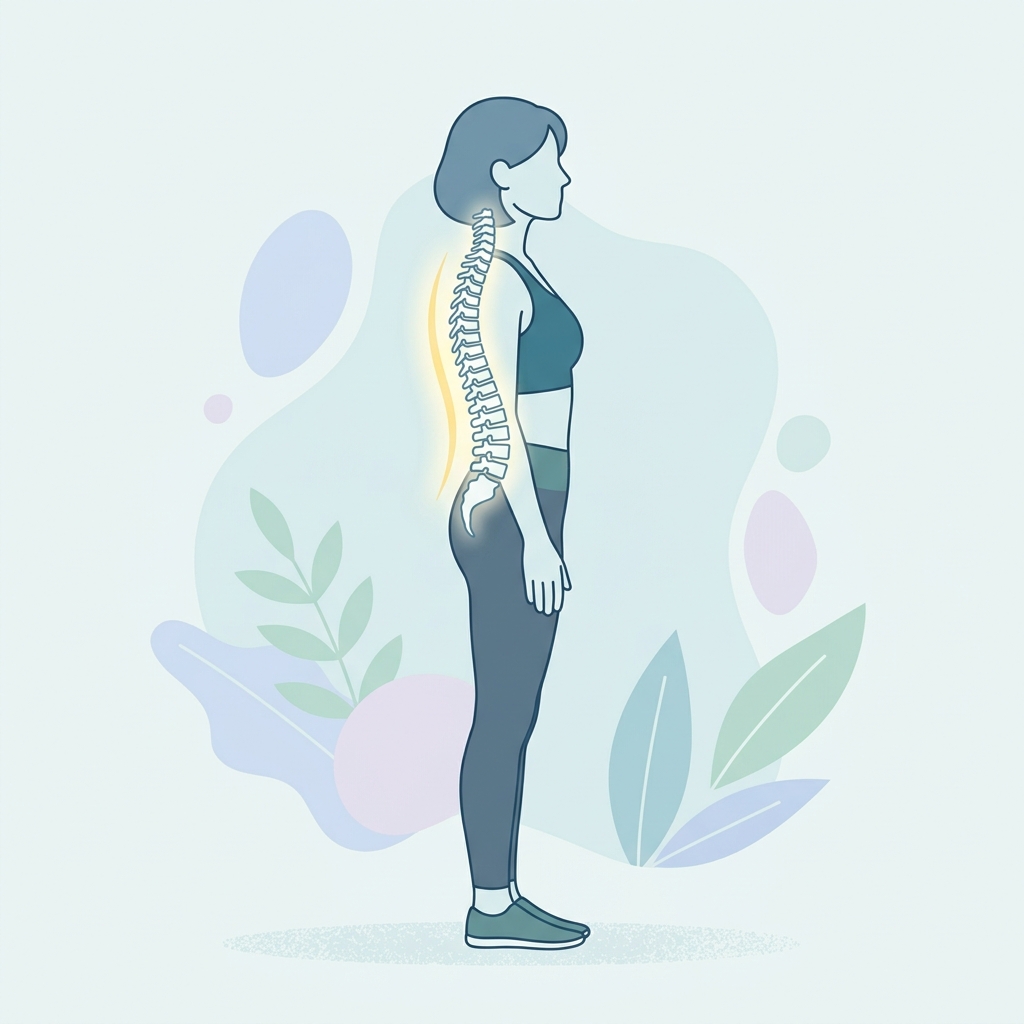
Postural Alignment and Thoracic Mobility Exercises
Step-by-step home exercise guide for Postural Alignment and Thoracic Mobility to improve thoracic extension and open the subacromial space.
Improving the flexibility of your mid-back (the thoracic spine) is a crucial, often overlooked component of shoulder health. A stiff or rounded upper back prevents your shoulder blade (scapula) from tilting backward and rotating upward when you lift your arm. This restriction narrows the subacromial space—the small passage beneath your collarbone where key tendons and tissues reside. This guide outlines dynamic stretches and strengthening exercises designed to restore your thoracic extension, improve your posture, and expand the subacromial space to relieve shoulder impingement and support recovery.
General Guidelines & Safety Precautions
To perform these exercises safely and effectively, keep the following principles in mind:
- Warm-Up First: Spend 5 minutes doing light activity, such as walking or gentle shoulder rolls, before starting the stretches.
- The Pain Rule: Exercises should feel like a deep stretch or mild muscle fatigue, but never sharp pain. If an exercise causes sharp or pinching pain, stop immediately.
- Move with Control: Focus on slow, deliberate movements. Do not use momentum or bounce.
- Breathe Continuously: Avoid holding your breath. Inhale as you expand or prepare, and exhale during the deepest part of the stretch.
The Home Exercise Program
Exercise 1: Foam Roller Thoracic Extension
Purpose: Direct mobilization of the thoracic spine into extension to counter forward slouching and restore vertical alignment.
Equipment Needed: Foam roller, yoga mat.
Starting Position: Lie on your back on a yoga mat. Position the foam roller horizontally across your mid-back (below your neck and above your lower back). Interlace your fingers behind your neck to support your head. Keep your knees bent and feet flat on the floor.
Instructions:
- Keep your buttocks firmly planted on the floor throughout the movement. Do not lift your hips.
- Gently lean backward over the foam roller, allowing your upper back to drape over the roller.
- Support the weight of your head with your hands; do not pull on your neck.
- Inhale as you extend backward, hold the stretch for 3 to 5 seconds, then exhale as you return to the start position.
- Move the foam roller up or down slightly (about 1 inch) to target different segments of your mid-back, and repeat the movement.
Dosage: 2 sets of 10 repetitions, once daily.
Tips & Common Mistakes: Do not arch your lower back or let your rib cage flare excessively. The extension should come from your upper and mid-back, not your lower back.
Exercise 2: Bench Thoracic Stretch
Purpose: Restores thoracic extension while stretching the latissimus dorsi and shoulder stabilizers, which helps open up the subacromial space.
Equipment Needed: A stable chair, bench, or ottoman.
Starting Position: Kneel on a soft mat in front of the bench. Place your elbows on the edge of the bench, shoulder-width apart, and clasp your hands together.
Instructions:
- Slowly sit your hips back toward your heels while allowing your chest to sink toward the floor between your arms.
- Let your head drop relaxed between your arms.
- Gently bend your elbows, bringing your hands toward the back of your neck to deepen the stretch in the shoulders.
- Hold this stretched position for 20 to 30 seconds while taking slow, deep breaths, then gently rise back up.
Dosage: 3 repetitions, twice daily.
Tips & Common Mistakes: Keep your core muscles slightly engaged to prevent your lower back from arching too much. Focus on feeling the stretch in your mid-back and underarms.
Exercise 3: Sidelying Open Book
Purpose: Improves rotational and extension mobility of the thoracic spine, allowing the shoulder blade to glide smoothly.
Equipment Needed: Yoga mat, pillow or foam block.
Starting Position: Lie on your side on the mat. Bend both knees to 90 degrees and stack them. Rest your head on a pillow. Extend both arms straight out in front of your chest, stacked together.
Instructions:
- Keep your knees pinned together and flat on the floor (you can hold them down with your bottom hand if needed).
- Slowly lift your top arm up toward the ceiling and continue rotating it over to the opposite side, opening your chest like a book.
- Follow your moving hand with your gaze, allowing your head and upper body to rotate.
- Open as far as comfortable, aiming to touch your top shoulder and arm to the floor behind you.
- Pause for 2 to 3 seconds, then slowly return to the starting position.
Dosage: 2 sets of 10 repetitions per side, once daily.
Tips & Common Mistakes: Do not let your knees slide apart or lift off the floor. The movement should occur through your torso, not your hips or lower back.
Exercise 4: Prone Cobra (Y-to-T Extension)
Purpose: Strengthens the thoracic extension muscles and lower scapular stabilizers to support an upright posture and maintain subacromial clearance.
Equipment Needed: Yoga mat.
Starting Position: Lie face down on the mat with your legs straight. Keep your forehead resting on the floor or slightly hovered, maintaining a neutral neck.
Instructions:
- Place your arms out to the sides at a 45-degree angle (forming a 'Y' shape) with your thumbs pointing up toward the ceiling.
- Squeeze your shoulder blades back and down, then slowly lift your chest, shoulders, and arms off the floor. Keep your gaze looking down at the mat to protect your neck.
- Hold this lifted position for 3 to 5 seconds, breathing normally.
- Gently lower back down to the floor.
- You can alternate between a 'Y' position and a 'T' position (arms straight out to the sides) to target different scapular stabilizers.
Dosage: 2 sets of 10 repetitions, once daily.
Tips & Common Mistakes: Avoid hyperextending your neck (don't look up). Keep the movement controlled and drive the lift by squeezing your shoulder blades together rather than straining your back.
Always consult with your physical therapist or doctor before starting a new exercise routine. If any exercise causes persistent pain or swelling, discontinue it and contact your healthcare provider.
Disclaimer: This guide provides general exercise instructions and is not a substitute for professional medical advice. Always consult your doctor or qualified healthcare provider with any questions you may have regarding your specific medical condition and treatment plan.

Related articles
Browse all articlesTrusted External Resources
Curated educational materials to help you make informed decisions about your orthopaedic bone & joint conditions.

Orthopaedia
Orthogate Patient Education