
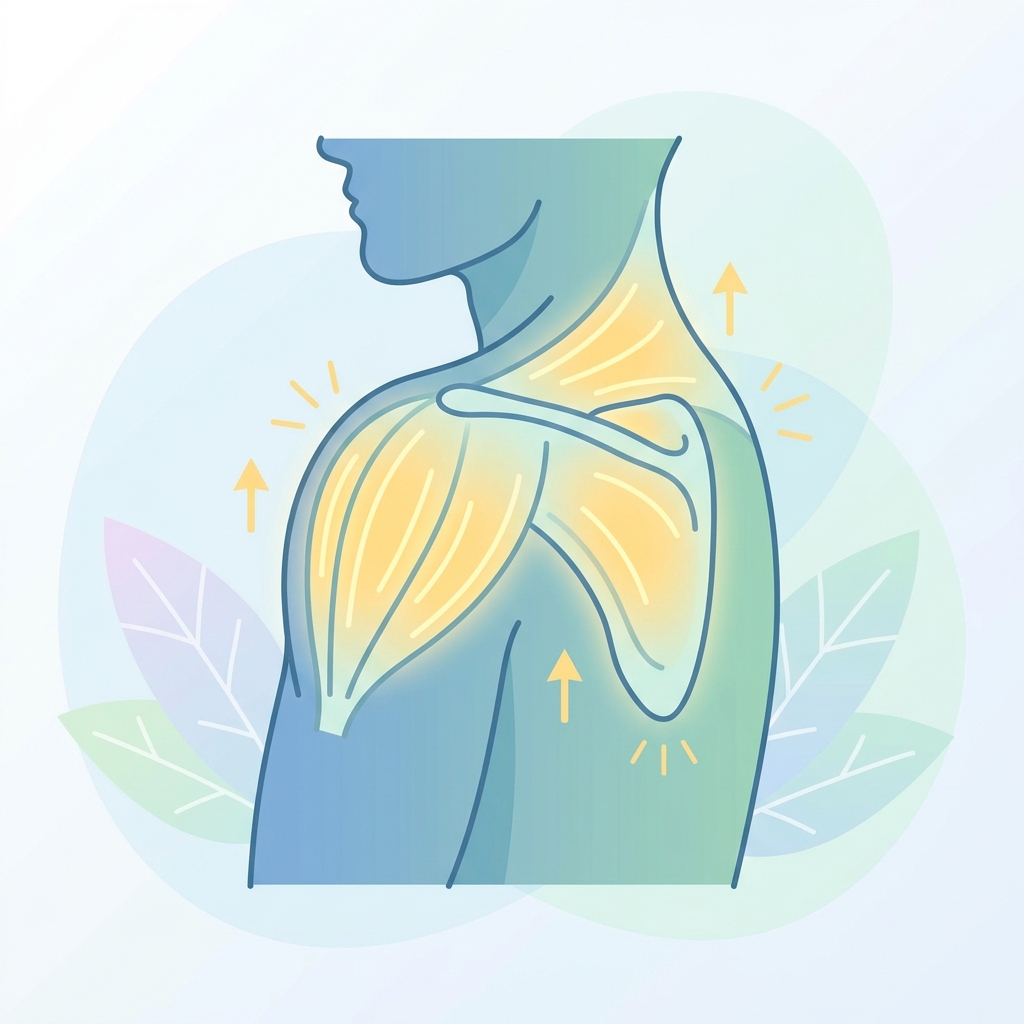
Non-Operative Rotator Cuff Tear Protocol
A phase-by-phase non-operative rehabilitation protocol for chronic or degenerative rotator cuff tears, emphasizing deltoid compensation and scapular stabilization.
Non-operative rehabilitation is a highly effective treatment pathway for chronic, degenerative rotator cuff tears, particularly in older populations or patients who choose not to undergo surgery. Research demonstrates that a structured physical therapy program focusing on compensating musculature can restore excellent shoulder function, reduce pain, and improve quality of life. The core philosophy of this protocol relies on two primary biomechanical principles: deltoid compensation (strengthening the anterior and lateral deltoid to take over the role of the torn rotator cuff in elevating the arm) and periscapular strengthening (stabilizing the shoulder blade to provide a solid foundation and optimize movement mechanics).
Phase I: Pain Control & Early Activation (Weeks 0-4)
- Goals:
- Control localized pain and joint inflammation.
- Establish early active-assisted range of motion (AAROM) within a pain-free boundary.
- Prevent compensatory shoulder shrugging.
- Develop basic scapular muscle awareness.
- Precautions & Restrictions:
- Do not stretch aggressively or push through sharp pain.
- Avoid lifting, carrying, or pushing heavy objects with the affected arm.
- Avoid active elevation if it triggers compensatory shrugging (subacromial catching).
- Suggested Exercises:
- Pendulum Exercises (Codman's): Lean forward supporting your body with the uninjured arm, letting the affected arm hang vertically. Gently sway the body to make small circles with the arm, promoting passive range of motion.
- Wand-Assisted Elevation: Lie on your back holding a cane or wand with both hands. Use your healthy arm to push the injured arm up into flexion, staying within a pain-free range.
- Supported Table Slides: Sit next to a table, place your hand on a towel, and slide your hand forward and diagonally to gently stretch the shoulder.
- Sub-Maximal Rotator Cuff Isometrics: Perform gentle internal and external rotation contractions against a wall or door frame with the arm at your side.
- Scapular Retraction and Depression: Squeeze your shoulder blades together and down, holding for 5 seconds to activate the rhomboids and lower trapezius.
- Criteria to Progress:
- Pain stable at 3/10 or less during simple, light activities of daily living.
- Passive/assisted shoulder flexion to at least 110-120 degrees with minimal pain.
- Demonstrated ability to perform isolated scapular retraction without shrugging.
Phase II: Deltoid Recruitment & Scapular Stabilization (Weeks 4-8)
- Goals:
- Actively recruit the anterior and lateral deltoid to compensate for the rotator cuff deficiency.
- Build endurance in the scapular stabilizers (serratus anterior, middle/lower trapezius).
- Establish unassisted active range of motion (AROM) in supported or gravity-eliminated positions.
- Precautions & Restrictions:
- Do not perform overhead lifts or carry heavy loads.
- Discontinue any exercise that causes a sharp pinch in the front or side of the shoulder.
- Suggested Exercises:
- Supine Active-Assisted to Active Flexion: Lie on your back. Use your healthy hand to lift the arm to 90 degrees, then slowly lower it under control. Gradually transition to unassisted lifts in this position to build anterior deltoid strength.
- Serratus punches: Lie on your back, raise your arm to 90 degrees, and push your hand toward the ceiling, lifting your shoulder blade off the floor.
- Standing External/Internal Rotation with Bands: Use a light resistance band. Keep your elbow tucked into your side (use a rolled towel under the armpit) and rotate the forearm outward or inward.
- Prone Scapular Sets (Y, T, W): Lie on your stomach (or lean forward over a table) and raise your arms into Y, T, and W positions to build periscapular endurance.
- Wall Crawls with Towel: Place a towel against a wall. Put your forearm on the towel and slide it upward, using the wall to support the weight of the arm.
- Criteria to Progress:
- Ability to actively raise the arm to 90 degrees in a supine position without pain or assistance.
- Good scapular control and posture during light daily tasks below shoulder level.
Phase III: Progressive Dynamic Strengthening (Weeks 8-12)
- Goals:
- Progress shoulder active range of motion (AROM) against gravity.
- Strengthen the remaining intact rotator cuff muscles to depress the humeral head.
- Maximize deltoid and scapular endurance for sustained everyday arm use.
- Precautions & Restrictions:
- Avoid lifting weights that cause the shoulder to shrug or hitch upward.
- Monitor for signs of tendon fatigue or pain flare-ups.
- Suggested Exercises:
- Standing Active Elevation (Flexion & Scaption): Lift your arm forward and diagonally, keeping the thumb pointing up. Raise only as high as possible without shrugging.
- Standing Band Rows: Secure a band to a door anchor. Pull back, squeezing the shoulder blades together.
- Resisted Wall Slides: Put a light loop band around your wrists. Press outward against the band and slide your forearms up the wall to engage both deltoid and scapulothoracic muscles.
- Light Dumbbell Scaption Raises: Hold a 1 to 2-pound dumbbell and perform raises in the scapular plane (30 degrees forward of the side) up to 90 degrees.
- Standing Band Punch-Outs: Stand facing away from the band anchor and press the band forward, focusing on the serratus anterior at the end of the movement.
- Criteria to Progress:
- Active shoulder elevation to 130-140 degrees (or functional maximum) without shrugging or pain.
- Demonstrated tolerance to progressive resistance training without next-day soreness.
Phase IV: Functional Maintenance & Conditioning (Weeks 12+)
- Goals:
- Maintain long-term joint mobility, strength, and deltoid compensation.
- Transition to a self-managed home exercise program (HEP).
- Safely return to specific work, household chores, or recreational activities.
- Precautions & Restrictions:
- Gradually ease into demanding household or overhead tasks.
- Avoid sudden, unconditioned heavy lifting or jerking movements.
- Suggested Exercises:
- Long-Term Maintenance Home Program: Perform a routine of bands (ER/IR, rows, presses) 2 to 3 times per week to preserve strength gains.
- Functional Reaching Drills: Practice reaching into high cupboards, lifting light boxes, and mimicking daily tasks with proper posture.
- Modified Lat Pull-downs: Use a cable machine or band, pulling down with a limited range to prevent subacromial compression.
- Modified Chest Press: Perform push-ups against a wall or counter, progressing to flat surfaces as tolerated.
- Criteria to Progress:
- Full independence with the home exercise program.
- Stable, functional shoulder control during all daily activities.
These guidelines represent a standard rehabilitation protocol. Individual recovery rates vary significantly depending on the size of the tear, muscle/tissue quality, and general patient health. Your physician or physical therapist may modify this protocol specifically for you.
Disclaimer: This protocol is for educational purposes and is not a substitute for professional medical advice. Always consult your surgeon or physical therapist before performing any exercises or modifying activity restrictions.

Related articles
Browse all articlesTrusted External Resources
Curated educational materials to help you make informed decisions about your orthopaedic bone & joint conditions.

Orthopaedia
Orthogate Patient Education