
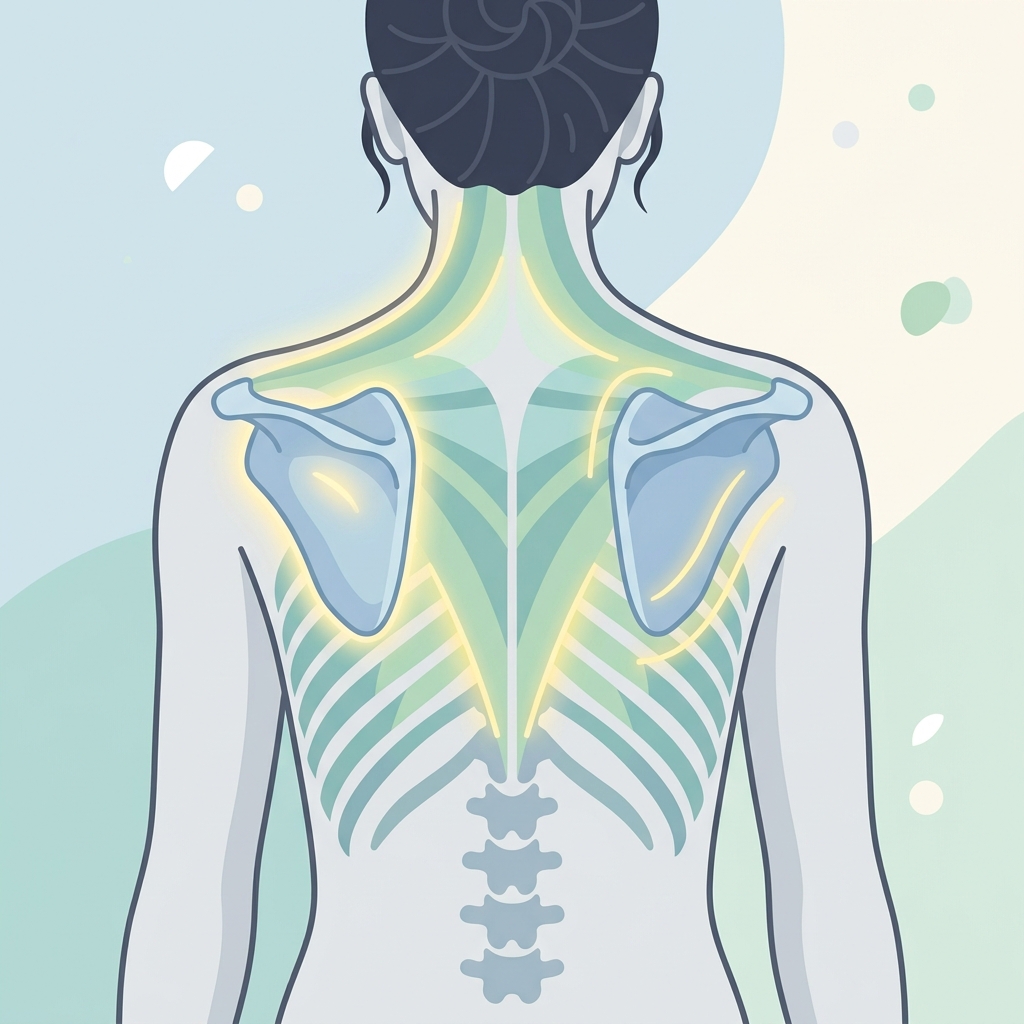
Scapular Dyskinesis Correction Protocol
A targeted, phase-based rehabilitation program focusing on periscapular strengthening and neuromuscular re-education of the trapezius and serratus anterior.
The scapula (shoulder blade) serves as the foundation for all shoulder movements. When the muscles supporting the scapula become weak or poorly coordinated—a condition known as scapular dyskinesis—the normal rhythm of the shoulder is disrupted, leading to pain, impingement, and decreased performance. This targeted rehabilitation program is designed to re-educate the nervous system and strengthen the key stabilizers of the scapula: the serratus anterior, lower trapezius, and middle trapezius, while stretching overactive muscles like the pectoralis minor.
Phase 1: Neuromuscular Re-Education & Joint Mobility (Weeks 1-3)
The primary focus of this early phase is to establish conscious control over scapular positioning, restore soft tissue flexibility, and eliminate compensatory shrugging movements.
Phase Goals:
- Establish conscious awareness of correct scapular resting position and movement.
- Restore flexibility to tight anterior structures (pectoralis minor, anterior capsule).
- Activate the serratus anterior and lower trapezius without over-activating the upper trapezius.
Precautions & Restrictions:
- Avoid active overhead elevation if it triggers shrugging or pain.
- Keep all exercises below 90 degrees of shoulder elevation unless scapular control is maintained.
- Stop any exercise that causes sharp, localized shoulder pain.
Suggested Exercises:
- Pectoralis Minor Corner Stretch: Stand in a corner with elbows bent at 90 degrees on the walls. Lean forward until a gentle stretch is felt in the chest. Hold for 30 seconds, repeat 3 times.
- Scapular Setting (Retraction and Depression): Squeeze the shoulder blades gently downward and together (as if sliding them into your back pockets). Hold for 5-10 seconds. Perform 2 sets of 10 repetitions.
- Supine Serratus Punches: Lie on your back holding a very light weight. Punch the arm straight up toward the ceiling, allowing the shoulder blade to lift off the table. Lower slowly. Perform 3 sets of 15 repetitions.
- Scapular Clocks: Place your hand on a wall. Move the shoulder blade up (12 o'clock), back (3 o'clock), down (6 o'clock), and forward (9 o'clock) in a controlled circle. Perform 2 sets of 10 circles in each direction.
Criteria to Progress:
- Ability to perform a static scapular squeeze for 10 seconds without shrugging or discomfort.
- Demonstrated understanding of scapular \"setting\" during simple arm movements.
- Improved resting posture with reduced anterior shoulder rounding.
Phase 2: Controlled Strengthening & Muscle Endurance (Weeks 4-8)
Once basic neuromuscular control is established, this phase progresses to strengthening the periscapular muscles throughout a larger range of motion and building muscular endurance.
Phase Goals:
- Build strength and endurance in the middle trapezius, lower trapezius, and serratus anterior.
- Maintain proper scapulohumeral rhythm during active movement up to 120 degrees.
- Improve core and kinetic chain integration during scapular exercises.
Precautions & Restrictions:
- Ensure the shoulder blade does not wing or tilt forward during exercises.
- Avoid excessive weights; focus on high-quality movement patterns over resistance.
- Monitor and limit upper trapezius activity (shrugging) during all movements.
Suggested Exercises:
- Scapular Wall Slides: Stand with your back against a wall, elbows and wrists touching the wall. Slide your arms up and down in a \"Y\" shape, keeping your shoulder blades pulled down. Perform 3 sets of 10-12 repetitions.
- Prone Blackburns (Y, T, W): Lie face down. Lift arms off the floor in a \"Y\", \"T\", and \"W\" position, focusing on squeezing the shoulder blades together and down. Hold each position for 3 seconds. Perform 2 sets of 10 repetitions.
- Wall Push-Up Plus: Perform a push-up against a wall. At the top of the movement, push your chest further away from the wall by protracting the shoulder blades. Perform 3 sets of 15 repetitions.
- Side-Lying External Rotation: Lie on your side, squeeze a small towel roll under your elbow, set your scapula, and rotate the forearm upward. Perform 3 sets of 12-15 repetitions.
Criteria to Progress:
- Symmetrical scapular motion during active arm elevation up to 120 degrees without winging.
- Ability to complete Phase 2 exercises with proper form and minimal upper trapezius fatigue.
Phase 3: Dynamic Integration & Functional Strength (Weeks 9-12+)
This final phase integrates scapular stability into multi-planar, dynamic, and functional movements to prepare the shoulder for return to sport, work, or daily overhead activities.
Phase Goals:
- Integrate periscapular control into complex, multi-joint movement patterns.
- Enhance dynamic scapular stabilization under high-velocity or loaded conditions.
- Transition to a long-term home maintenance and conditioning program.
Precautions & Restrictions:
- Do not progress resistance if form degrades or dynamic winging occurs.
- Maintain strict kinetic chain posture (avoid arching the lower back to compensate).
Suggested Exercises:
- Dynamic Hug: Wrap a resistance band around your back, hold the ends, and push forward and slightly inward as if hugging a large tree, emphasizing scapular protraction. Perform 3 sets of 12 repetitions.
- Prone Ys and Ts on Stability Ball: Lie prone with your chest supported on a stability ball. Perform Y and T arm raises to challenge core and scapular stability simultaneously. Perform 3 sets of 10-12 repetitions.
- Diagonal PNF Patterns (D1/D2): Use a resistance band to pull diagonally across your body, focusing on the rotation and elevation of the scapula. Perform 3 sets of 10 repetitions per side.
- Serratus Plank: Hold a forearm plank position. Push through your elbows to round the upper back slightly (protraction), hold for 2 seconds, then return to neutral. Perform 3 sets of 30-45 seconds.
Criteria to Progress/Discharge:
- Full, pain-free active range of motion with symmetrical scapular motion.
- Periscapular muscle strength matching the unaffected side (or within 10%).
- Consistent scapular stability during functional, sport-specific, or work-related tasks.
- Independent mastery of the home maintenance exercises.
These guidelines represent a standard rehabilitation protocol. Individual recovery rates vary significantly depending on the severity of the dyskinesis, tissue quality, and general patient health. Your surgeon or physical therapist may modify this protocol specifically for you.
Disclaimer: This protocol is for educational purposes and is not a substitute for professional medical advice. Always consult your surgeon or physical therapist before performing any exercises or modifying activity restrictions.

Related articles
Browse all articlesTrusted External Resources
Curated educational materials to help you make informed decisions about your orthopaedic bone & joint conditions.

Orthopaedia
Orthogate Patient Education