Dumbbell Progressions: Scaption and Prone Horizontal Abduction (Phase 2) Exercises
Step-by-step home exercise guide for Dumbbell Progressions (Phase 2) to improve shoulder strength, stability, and movement control.
As you progress to Phase 2 of your shoulder rehabilitation, the focus shifts to introducing light resistance and working against gravity. Dumbbell progressions are excellent for building strength in the rotator cuff and periscapular muscles. This guide introduces gravity-resisted movements like scaption and prone horizontal abduction, helping you transition from basic motion to active, loaded control.
General Guidelines & Safety Precautions
- Warm-up First: Always begin with a brief warm-up, such as shoulder rolls or active-assisted movements, to increase blood flow to the joint.
- The Pain Rule: Exercises should feel challenging but not cause sharp or radiating pain. If you experience a sharp pinch or sudden pain, stop the movement immediately.
- Control is Key: Move slowly and deliberately. Do not use momentum to swing the dumbbells.
- Start Light: Begin with very light weights (1 to 2 pounds). Proper form is much more important than the amount of weight lifted.
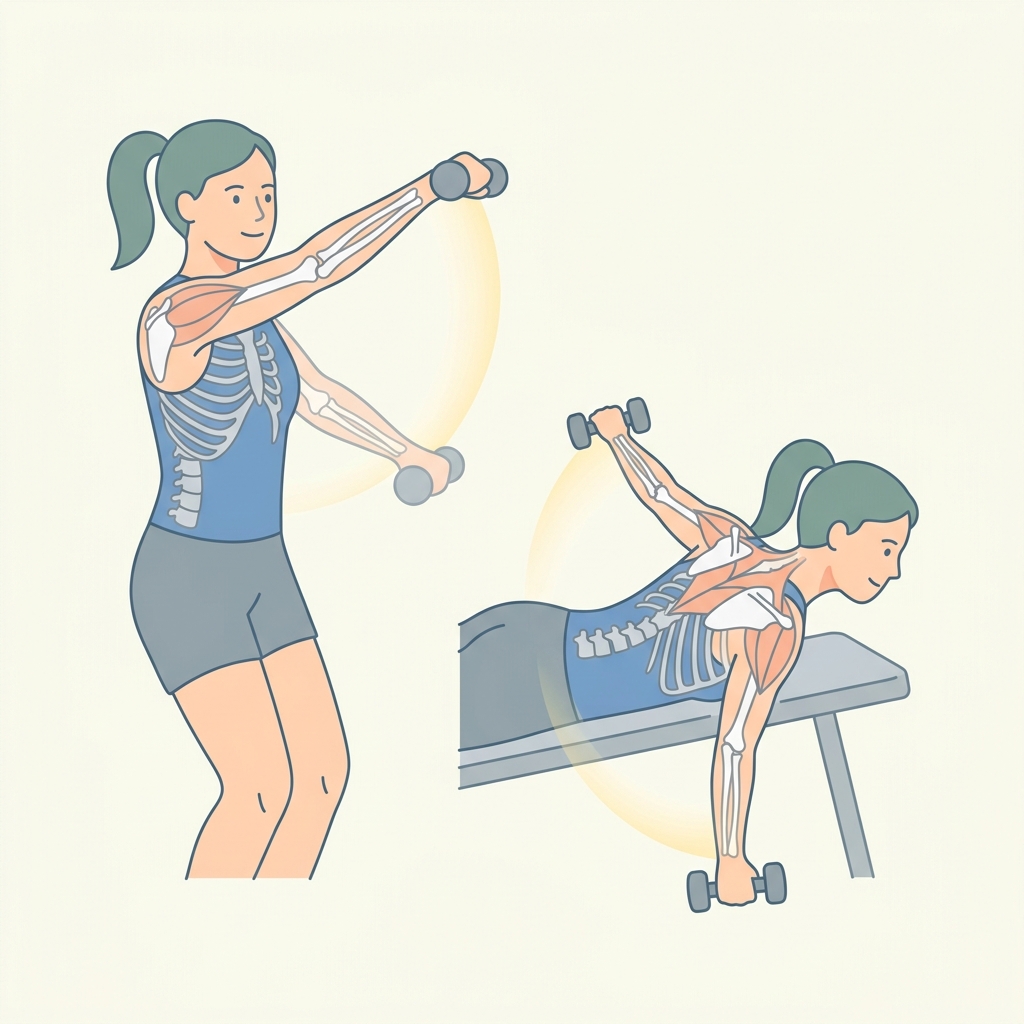
Exercise 1: Dumbbell Scaption (Elevation in Scapular Plane)
Purpose: Strengthens the supraspinatus (upper rotator cuff) and the serratus anterior, promoting optimal shoulder mechanics as you lift your arms.
Equipment Needed: Light dumbbell (1 to 3 lbs).
Starting Position: Stand tall with feet shoulder-width apart, holding a light dumbbell in each hand at your sides. Your palms should face forward, and thumbs should point slightly upward.
Step-by-Step Instructions:
- Slightly retract your shoulder blades, pulling them down and together.
- Raise your arms upward and outward at approximately a 30 to 45-degree angle forward from your body (forming a \"V\" shape).
- Keep your thumbs pointing upward throughout the entire movement.
- Stop when your arms reach shoulder height (90 degrees). Do not lift higher.
- Pause for 1 to 2 seconds at the top, then slowly lower your arms back to the starting position.
Dosage: Perform 2 to 3 sets of 10 to 12 repetitions, 3 to 4 days per week.
Tips & Mistakes to Avoid: Avoid shrugging your shoulders toward your ears as you lift. Do not arch your lower back; keep your core engaged.
Exercise 2: Prone Horizontal Abduction (Prone \"T\")
Purpose: Strengthens the posterior rotator cuff (infraspinatus and teres minor) and middle trapezius, which are critical for shoulder stability and posture.
Equipment Needed: Sturdy flat bench, bed, or table, and a light dumbbell (1 to 2 lbs).
Starting Position: Lie face down (prone) on a bench or bed. If on a bed, position your shoulder right at the edge so your arm can hang straight down toward the floor. Hold a light dumbbell with your thumb pointing outward (away from your body).
Step-by-Step Instructions:
- Let your arm hang straight down, relaxing the shoulder girdle.
- Slowly raise your arm out to the side, keeping your elbow straight, until your arm is parallel to the floor (forming a \"T\" shape with your body).
- Keep your thumb pointing toward the ceiling or outward during the lift to maximize external rotation.
- Squeeze your shoulder blade inward toward your spine at the top of the movement.
- Hold for 1 to 2 seconds, then slowly lower the dumbbell back to the starting position.
Dosage: Perform 2 to 3 sets of 10 repetitions, 3 days per week.
Tips & Mistakes to Avoid: Do not let your shoulder drop forward or shrug up toward your ear. Keep the motion slow and controlled; do not fling the weight.
Exercise 3: Prone Row to External Rotation
Purpose: Trains coordinate firing of the scapular stabilizers (rhomboids and trapezius) and the external rotators of the rotator cuff.
Equipment Needed: Flat bench or bed, light dumbbell (1 to 3 lbs).
Starting Position: Lie face down on a bench or the edge of a bed, letting your arm hang straight down toward the floor while holding a light dumbbell. Your palm should face backward.
Step-by-Step Instructions:
- Pull your elbow straight up toward the ceiling (rowing motion) until your upper arm is aligned with your torso. Your elbow should be bent at a 90-degree angle.
- While keeping your elbow bent and in line with your body, rotate your forearm upward until it is parallel to the floor (external rotation).
- Pause at the top for 1 to 2 seconds, squeezing your shoulder blades together.
- Slowly reverse the rotation so your forearm points down again.
- Lower your arm back to the starting hanging position.
Dosage: Perform 2 sets of 10 repetitions, 3 days per week.
Tips & Mistakes to Avoid: Keep your elbow stable during the rotation phase; do not let it drop toward the floor. Use a very light weight as the rotation part is challenging.
Exercise 4: Sidelying External Rotation
Purpose: Target and strengthen the infraspinatus and teres minor (posterior rotator cuff) against gravity.
Equipment Needed: A mat or bed, a small rolled towel, and a light dumbbell (1 to 2 lbs).
Starting Position: Lie on your side on a bed or mat, with your affected shoulder on top. Place a small, rolled towel between your upper arm and your side. Bend your elbow to 90 degrees, holding the dumbbell in front of your stomach.
Step-by-Step Instructions:
- Keep your elbow tucked firmly against the rolled towel at your side.
- Slowly rotate your forearm upward, raising the dumbbell toward the ceiling as far as comfortable.
- Stop when your forearm is slightly past vertical or when you feel a gentle contraction in the back of your shoulder.
- Pause for 1 to 2 seconds, then slowly lower the dumbbell back to the starting position in front of your stomach.
Dosage: Perform 2 to 3 sets of 12 repetitions, 3 to 4 days per week.
Tips & Mistakes to Avoid: Do not roll your body backward to help lift the weight. The movement should come purely from the shoulder joint. Keep your elbow pinned to the towel.
Always consult with your physical therapist or doctor before starting a new exercise routine. If any exercise causes persistent pain or swelling, discontinue it and contact your healthcare provider.
Disclaimer: This guide provides general exercise instructions and is not a substitute for professional medical advice. Always consult your doctor or qualified healthcare provider with any questions you may have regarding your specific medical condition and treatment plan.

Related articles
Browse all articlesTrusted External Resources
Curated educational materials to help you make informed decisions about your orthopaedic bone & joint conditions.

Orthopaedia
Orthogate Patient Education