
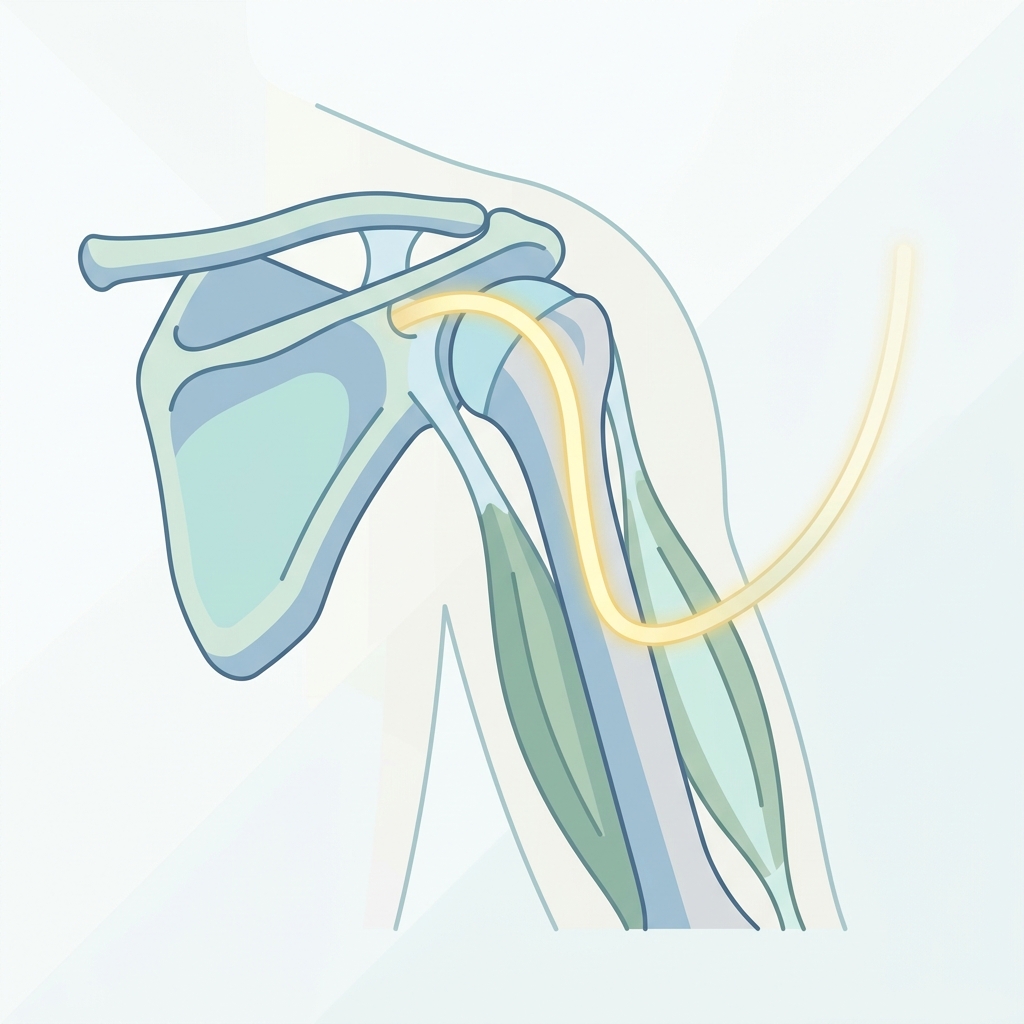
Biceps Tenodesis Protocol
Phase-by-phase post-operative rehabilitation protocol for Biceps Tenodesis to guide recovery and physical therapy.
An arthroscopic or open biceps tenodesis is performed to surgically reattach the long head of the biceps tendon from its attachment on the glenoid labrum to the proximal humerus (upper arm bone). This procedure is designed to alleviate shoulder pain and restore function. Proper rehabilitation is critical to protect the healing tendon repair site, particularly during the first six weeks when the biceps must not be loaded actively.
Phase 1: Protection and Early Motion (Weeks 0-6)
Goals:
- Protect the biceps tenodesis tendon repair site.
- Minimize shoulder pain, inflammation, and muscle guarding.
- Maintain passive range of motion (PROM) in the shoulder and elbow.
- Prevent joint contracture and adhesions.
Precautions & Restrictions:
- Wear the sling at all times (including sleep) for the first 4 weeks, except during exercises and hygiene. Discontinue sling at week 6 or as directed.
- Strict restriction: No active elbow flexion or forearm supination (no active biceps contraction).
- No resisted shoulder or elbow flexion.
- No lifting or carrying objects with the surgical arm.
- Limit shoulder passive range of motion: elevation to 90 degrees, external rotation to 30 degrees in the scapular plane, internal rotation as tolerated.
Suggested Exercises:
- Pendulum (Codman) exercises.
- Passive shoulder range of motion: elevation, flexion, external/internal rotation in the scapular plane (within limits).
- Passive elbow range of motion (flexion and extension) to maintain elbow mobility without activating the biceps. Active elbow extension is permitted, but elbow flexion must be entirely passive/assisted.
- Grip strengthening (e.g., squeeze a stress ball).
- Active range of motion of the wrist and fingers.
- Submaximal shoulder isometric exercises (except biceps flexion).
- Scapular clocks and gentle retraction/depression.
Criteria to Progress:
- Completion of the 6-week protection phase.
- Tolerable shoulder pain and minimal inflammation.
- Restored passive shoulder flexion to at least 90 degrees and external rotation to 30 degrees.
Phase 2: Active ROM & Early Strengthening (Weeks 6-10)
Goals:
- Gradually discontinue the sling (typically by week 6).
- Restore full active-assisted and active range of motion (AAROM/AROM) of the shoulder.
- Re-establish normal scapulohumeral rhythm.
- Initiate gentle active contraction of the biceps (without resistance).
- Start light strengthening of the rotator cuff and scapular stabilizers.
Precautions & Restrictions:
- No resisted biceps loading (no curls, no resisted elbow flexion or supination).
- Avoid sudden pulling, lifting, or carrying heavy objects (limit to 2-5 lbs).
- Avoid end-range aggressive stretching of the shoulder and biceps.
Suggested Exercises:
- Active-assisted and active range of motion (wall slides, cane exercises, pulleys) progressing to full active range of motion in all planes.
- Active elbow range of motion (elbow flexion and supination without weights or resistance).
- Rotator cuff strengthening: gentle resisted external and internal rotation using therabands or light weights (1-2 lbs), keeping the elbow bent at 90 degrees with a towel roll under the arm.
- Scapular strengthening: rows, Y/T/W exercises, serratus punches, and chest press progressions with light resistance.
- Light dynamic stabilization exercises (e.g., active shoulder elevation in a pain-free range).
Criteria to Progress:
- Pain-free active range of motion of the shoulder in all planes.
- Normal scapulohumeral rhythm during active elevation.
- Ability to perform active elbow flexion without pain or compensation.
Phase 3: Resisted Strengthening & Biceps Loading (Weeks 10-14)
Goals:
- Restore full active shoulder range of motion.
- Progressively load the biceps tendon with light, controlled resistance.
- Re-establish optimal strength, endurance, and dynamic stability of the rotator cuff and scapulothoracic muscles.
Precautions & Restrictions:
- Progress biceps strengthening slowly and monitor for tendonitis (front of the shoulder pain).
- Avoid heavy lifting, sudden loading, or high-impact activities.
- No heavy loaded pull-ups, chin-ups, or heavy curls.
Suggested Exercises:
- Progressive rotator cuff and scapular strengthening with increased resistance (therabands, dumbbells).
- Gentle resisted biceps strengthening: light dumbbell curls, hammer curls, and resisted forearm supination (start with 1-2 lbs and progress slowly).
- Eccentric elbow flexion exercises (slow lowering of light weights) to build tendon resilience.
- Closed kinetic chain exercises: wall push-ups, modified planks, quadruped weight-shifting.
- Dynamic stabilization exercises: ball on wall, PNF patterns.
Criteria to Progress:
- Near-full or full shoulder strength compared to the unaffected side.
- Pain-free resisted elbow flexion and supination.
- Good scapular stability during resisted exercises.
Phase 4: Advanced Conditioning & Return to Sport/Work (Weeks 14+)
Goals:
- Maximize strength, power, and muscle endurance of the shoulder complex.
- Progress biceps loading to normal functional, sport, or occupational levels.
- Safely transition back to full, unrestricted athletic or manual work activities.
Precautions & Restrictions:
- Avoid premature participation in contact sports or heavy manual lifting until cleared by the surgeon.
- Maintain proper exercise technique and avoid overtraining.
Suggested Exercises:
- Advanced strengthening exercises (push-ups, pull-ups, overhead pressing, chest press) with progressive loading.
- High-velocity biceps loading and eccentric exercises.
- Sport-specific or work-specific drills (e.g., throwing progression, lifting objects from floor to overhead).
- Plyometric exercises (medicine ball tosses, chest passes, decelerations).
Criteria to Progress:
- Clearance from the orthopaedic surgeon.
- Pain-free completion of sport-specific or work-specific conditioning.
- Shoulder strength matching at least 90% of the unaffected side.
- Full, pain-free active range of motion of the shoulder and elbow.
These guidelines represent a standard rehabilitation protocol. Individual recovery rates vary significantly depending on the size of the repair, bone/tissue quality, and general patient health. Your surgeon may modify this protocol specifically for you.
Disclaimer: This protocol is for educational purposes and is not a substitute for professional medical advice. Always consult your surgeon or physical therapist before performing any exercises or modifying activity restrictions.
Related articles
Browse all articlesTrusted External Resources
Curated educational materials to help you make informed decisions about your orthopaedic bone & joint conditions.

Orthopaedia
Orthogate Patient Education