Calcific Tendonitis Protocol
A phase-based non-operative rehabilitation protocol for calcific tendonitis of the rotator cuff, focusing on pain management and eccentric loading to address calcium deposits.
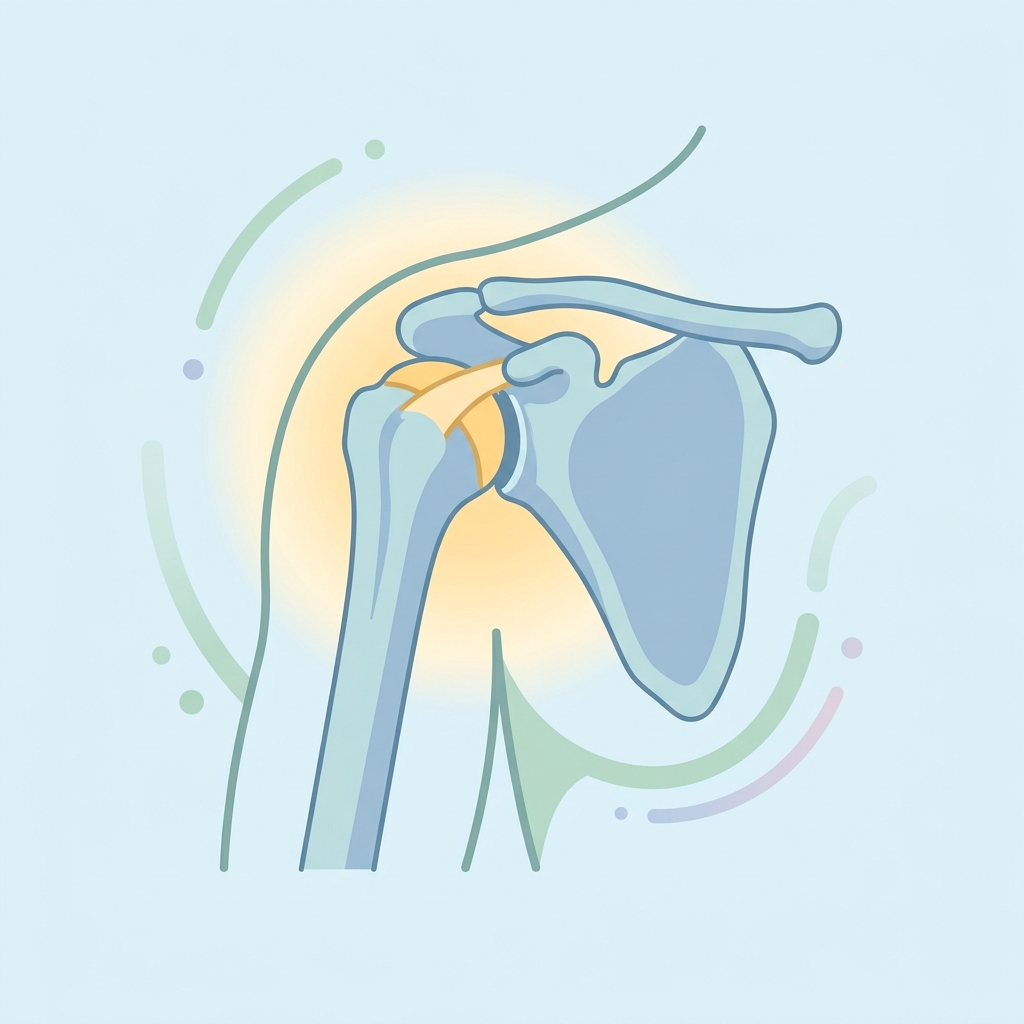
Calcific tendonitis of the rotator cuff occurs when calcium deposits build up in the tendons (most commonly the supraspinatus tendon). This non-operative rehabilitation protocol focuses on systematic progression across three phases: initial pain control and passive motion, recovery of active range of motion with early rotator cuff/scapular stabilization, and a dedicated late-stage eccentric loading program. Eccentric loading is highly emphasized as it increases mechanical stress on the tendon in a controlled manner, stimulates tendon remodeling, helps break down or resorb calcium deposits, and improves the overall structural integrity of the rotator cuff.
Phase I: Pain Management & Range of Motion (Weeks 0 to 4)
Goals:
- Control acute pain and inflammation associated with the formative or resorptive phases of calcific tendonitis.
- Maintain and restore passive and active-assisted range of motion (ROM) to prevent shoulder stiffness.
- Initiate gentle, sub-maximal rotator cuff activation in pain-free positions.
Precautions & Restrictions:
- Avoid impingement positions (e.g., end-range elevation with internal rotation).
- No heavy lifting, carrying, or pushing with the affected arm.
- Avoid stretching or activities that provoke sharp, pinching joint pain.
Suggested Exercises:
- Pendulum exercises (Codman's) for passive joint distraction and pain relief.
- Passive and active-assisted range of motion (AAROM) using a cane/wand or pulley system in flexion, scaption, and external rotation (limited to pain-free range).
- Periscapular activation: scapular squeezes (retractions), shrugs, and scapular depressions.
- Sub-maximal isometrics: gentle external rotation, internal rotation, and abduction performed with the arm at the side (neutral position).
Criteria to Progress:
- Substantial reduction in resting pain and nocturnal discomfort.
- Active-assisted range of motion showing progressive improvement (flexion to at least 120° and external rotation to 30°).
- Ability to perform sub-maximal isometrics without triggering acute pain.
Phase II: Active ROM & Early Strengthening (Weeks 4 to 8)
Goals:
- Restore full, pain-free active range of motion (AROM) in all planes.
- Establish optimal scapulohumeral rhythm and control.
- Progress from isometric activation to light, concentric rotator cuff and periscapular strengthening.
Precautions & Restrictions:
- Avoid repetitive overhead tasks or lifting.
- Monitor post-exercise symptoms: soreness should resolve within 24 hours of training.
- Modify exercises if pinching or impingement signs are observed during active elevation.
Suggested Exercises:
- Active range of motion progression: standing flexion, scaption, and external rotation without compensation.
- Scapular strengthening: rows, low rows, T's, Y's, and W's (prone or using light resistance bands).
- Rotator cuff concentric strengthening: resistance band external rotation, internal rotation, and scaption (punches/deltoid raises up to 90°).
- Serratus anterior activation: wall slides and scapular push-ups.
Criteria to Progress:
- Full active range of motion in flexion and external rotation without pain or compensatory shrugging.
- Scapular control maintained throughout active movement.
- Good tolerance to light concentric resistance exercises.
Phase III: Eccentric Loading & Remodeling (Weeks 8 to 12+)
Goals:
- Introduce targeted eccentric loading to facilitate tendon remodeling and address calcium deposits.
- Maximize strength, local muscular endurance, and power of the rotator cuff and scapular stabilizers.
- Integrate kinetic chain movement and facilitate return to full vocational and recreational activities.
Precautions & Restrictions:
- Avoid sudden, high-velocity eccentric loading in early stages; build up speed and load gradually.
- Do not ignore sharp, localized tendon pain during or after eccentric activities.
- Perform exercises with strict control, avoiding fatigue-induced compensatory movements.
Suggested Exercises:
- Eccentric external rotators: assist the arm into full external rotation, then slowly lower the arm (3-5 seconds) against resistance band or hand weight.
- Eccentric supraspinatus: raise the arm into scaption concentrically using both hands, then slowly lower the affected arm alone (3-5 seconds).
- Eccentric internal rotators: assist the arm into internal rotation, then slowly return to the starting position against band resistance.
- Progressive overhead pressing: concentric press followed by a slow, controlled eccentric descent.
- Functional patterns: diagonal chops/lifts, and light plyometrics (ball tosses, wall rebounders) as tolerated for return-to-sport or high-demand work.
Criteria to Progress:
- Symmetrical rotator cuff strength (within 10-15% of the unaffected arm).
- Pain-free execution of the eccentric loading program.
- Complete, pain-free return to daily living, occupational, or recreational activities.
These guidelines represent a standard non-operative rehabilitation protocol. Individual recovery rates vary significantly depending on the size and location of the calcium deposits, the stage of calcific tendonitis (formative vs. resorptive), and general patient health. Your physician or physical therapist may modify this protocol specifically for you.
Disclaimer: This protocol is for educational purposes and is not a substitute for professional medical advice. Always consult your doctor or physical therapist before performing any exercises or modifying activity restrictions.

Related articles
Browse all articlesTrusted External Resources
Curated educational materials to help you make informed decisions about your orthopaedic bone & joint conditions.

Orthopaedia
Orthogate Patient Education