
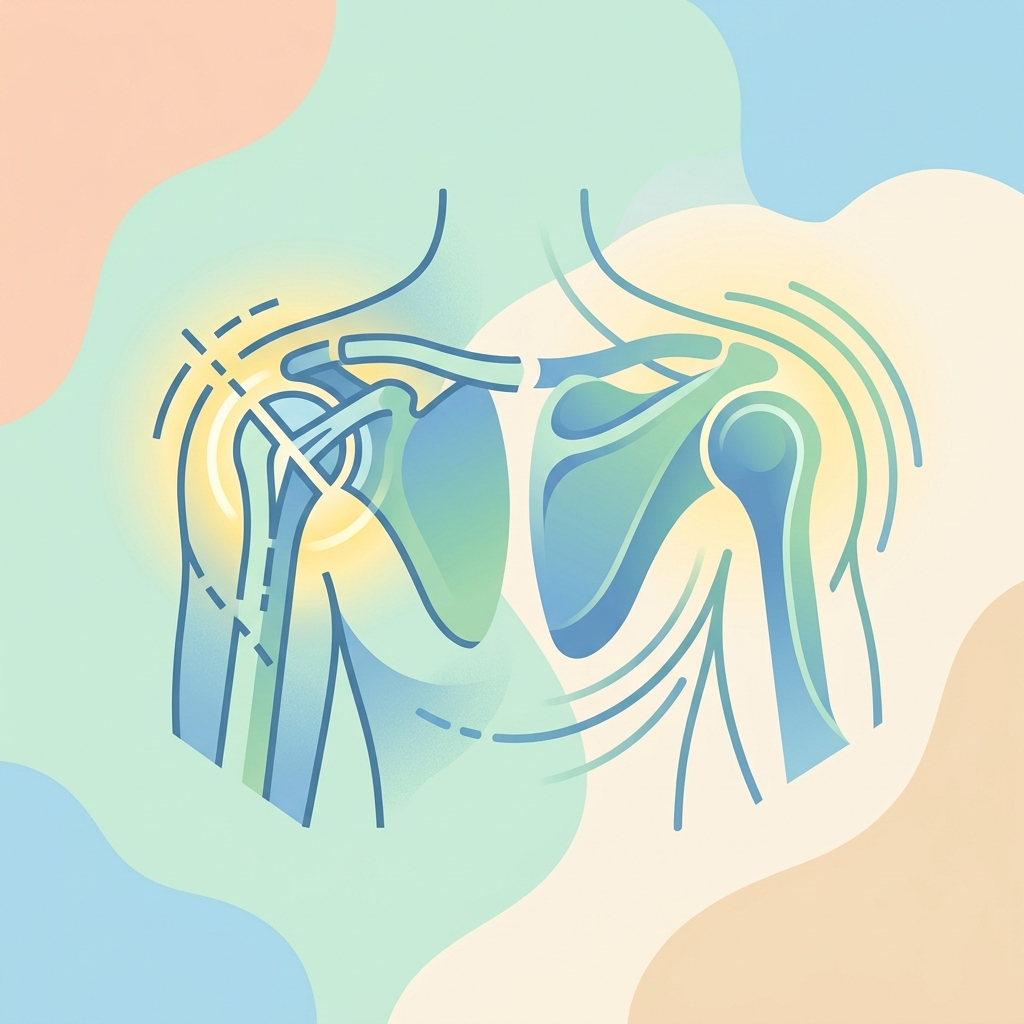
Total Shoulder Arthroplasty (Anatomic) Protocol (Patients with Standard Subscapularis Detachment Only)
Phase-by-phase post-operative rehabilitation protocol for Total Shoulder Arthroplasty (Anatomic) for patients with standard subscapularis detachment to guide recovery.
An anatomic Total Shoulder Arthroplasty (TSA) involves replacing the damaged humeral head (ball) and glenoid (socket) of the shoulder joint. To access the joint during this surgery, the surgeon performs a standard subscapularis detachment (either tenotomy or lesser tuberosity osteotomy). At the conclusion of the surgery, the subscapularis tendon is meticulously repaired back to its anatomical insertion. Protecting this subscapularis tendon repair is the most critical component of early rehabilitation. Tension on the repaired tendon must be minimized to allow for proper tendon-to-bone healing, which means avoiding active internal rotation and limiting passive external rotation during the initial recovery phase.
Phase 1: Protective Phase (Weeks 0 - 6)
Phase Goals:
- Protect the subscapularis repair and allow surgical tissues to heal.
- Re-establish passive range of motion (PROM) and active-assisted range of motion (AAROM).
- Manage pain, swelling, and inflammation.
- Maintain active mobility of the elbow, wrist, and hand.
Precautions & Restrictions:
- No active internal rotation (IR): Avoid active internal rotation against gravity or resistance (e.g., reaching behind the back or pulling against resistance) to prevent subscapularis disruption.
- Limit passive external rotation (ER): Restrict passive external rotation to a maximum of 30 degrees (typically measured with the arm at 30 degrees of abduction) to avoid stretching the repair.
- Limit passive flexion: Restrict passive flexion/elevation to 120 degrees.
- Sling wear: Wear the sling at all times, including during sleep, except when showering or performing exercises.
- No lifting: No lifting of any objects or bearing weight through the surgical arm.
Suggested Exercises:
- Pendulum (Codman’s) Exercises: Passive distraction of the glenohumeral joint using gravity and body momentum for gentle movement.
- Passive Shoulder Flexion: Performed in supine, lifting the surgical arm with the non-surgical arm (limit to 120 degrees).
- Passive External Rotation: Performed in supine, using a cane or stick to rotate the arm outward (limit to 30 degrees).
- Elbow, Wrist, and Hand AROM: Actively moving the elbow, wrist, and fingers to prevent stiffness and reduce distal swelling.
- Submaximal Scapular Shrugs and Retraction: Gentle shoulder blade movements to maintain scapular mobility.
Criteria to Progress:
- Completion of the 6-week post-operative mark.
- Passive shoulder flexion to at least 90 degrees and passive external rotation to 30 degrees without significant pain.
- Minimal resting pain and stable subscapularis repair verified by the clinical team.
Phase 2: Active Motion and Early Strengthening (Weeks 6 - 12)
Phase Goals:
- Gradually discontinue the use of the sling.
- Transition from passive to full active range of motion (AROM) in all planes.
- Restore normal scapulohumeral rhythm and glenohumeral mechanics.
- Initiate light isometric and early dynamic rotator cuff and scapular strengthening.
Precautions & Restrictions:
- No heavy lifting: Do not lift objects heavier than 1 to 2 pounds.
- Subscapularis precaution: Avoid resisted active internal rotation (IR) until week 8. After week 8, introduce only light, pain-free resistance.
- Avoid combined movement extremes: Avoid combining abduction and external rotation (the \"high-five\" position) to prevent anterior capsule strain.
Suggested Exercises:
- Active-Assisted Range of Motion (AAROM): Progressing flexion and external rotation using a pulley or cane.
- Active Range of Motion (AROM): Supine active flexion progressing to standing active flexion, scaption, and external rotation as tolerated.
- Submaximal Isometrics: Pain-free isometric contractions for shoulder external rotation, flexion, abduction, and extension.
- Gentle Internal Rotation (IR) Activation (Starting Week 8): Submaximal isometric internal rotation or light resistance band IR (yellow band) if pain-free.
- Scapular Strengthening: Prone scapular retraction (rows), shrugs, and serratus punches.
Criteria to Progress:
- Active shoulder flexion to at least 120 degrees and external rotation to 45 degrees.
- Control of scapular movement during active elevation (no excessive shoulder shrugging).
- Ability to lift 2 to 3 pounds pain-free during structured exercises.
Phase 3: Dynamic Strengthening and Functional Recovery (Weeks 12 - 18+)
Phase Goals:
- Re-establish full strength, endurance, and power of the rotator cuff and scapular stabilizers.
- Optimize dynamic joint stability.
- Gradually return to activities of daily living, work, and recreational pursuits.
Precautions & Restrictions:
- Gradual progressive loading: Avoid sudden increases in lifting weights or high-velocity impact.
- Listen to the joint: Exercises must remain pain-free; avoid pushing through sharp or pinching pain.
Suggested Exercises:
- Rotator Cuff Strengthening: Progressive resistance exercises (PRE) for external rotation, internal rotation, abduction, and flexion using bands or light dumbbells (progressing weight as tolerated).
- Periscapular and Deltoid Strengthening: Row progressions, lat pulldowns, chest presses (modified depth), and shoulder press below 90 degrees.
- Dynamic Stabilization: Quadruped weight-bearing exercises, rhythmic stabilization in standing or wall-slides.
- Functional and Sport-Specific Training: Work-related or recreational movement pattern simulation.
Criteria to Progress:
- Full, pain-free active range of motion compared to the contralateral side.
- Rotator cuff and periscapular strength at least 80% to 90% of the non-surgical arm.
- Successful completion of a home exercise program maintenance routine.
- Clearance from the surgeon for return to heavy labor, contact sports, or lifting.
These guidelines represent a standard rehabilitation protocol. Individual recovery rates vary significantly depending on the size of the repair, bone/tissue quality, and general patient health. Your surgeon may modify this protocol specifically for you.
Disclaimer: This protocol is for educational purposes and is not a substitute for professional medical advice. Always consult your surgeon or physical therapist before performing any exercises or modifying activity restrictions.

Related articles
Browse all articlesTrusted External Resources
Curated educational materials to help you make informed decisions about your orthopaedic bone & joint conditions.

Orthopaedia
Orthogate Patient Education