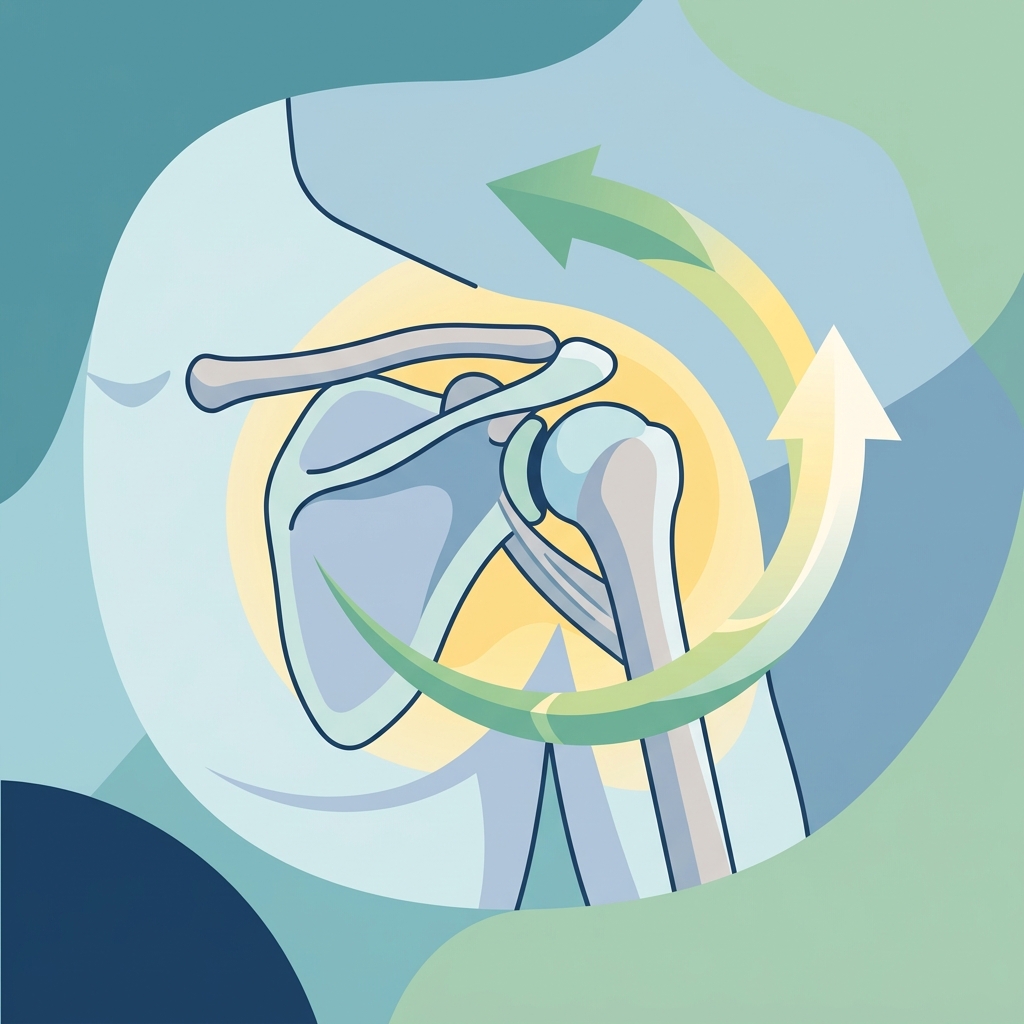
Arthroscopic Rotator Cuff Repair – Accelerated Protocol
Phase-by-phase post-operative rehabilitation protocol for Arthroscopic Rotator Cuff Repair – Accelerated Protocol to guide recovery and physical therapy.
An accelerated rehabilitation protocol after arthroscopic rotator cuff repair is designed to promote early mobility and minimize stiffness while carefully protecting the healing tendon-to-bone interface. This protocol is typically indicated for patients with small to medium-sized tears, excellent tissue and bone quality, and low risk of repair failure. Early controlled motion helps prevent capsular adhesions and muscle atrophy, facilitating a faster recovery of active shoulder function under close supervision.
Phase I: Early Range of Motion & Protection (Weeks 0-4)
Goals:
- Protect tendon-to-bone healing and surgical repair integrity
- Wean from the sling during the day by week 4 (except in crowded environments)
- Restore passive range of motion (PROM) to: Flexion > 120°, Abduction > 90°, External Rotation to 30°
- Minimize muscle guarding and control post-operative pain
Precautions & Restrictions:
- No active shoulder elevation (no active abduction or flexion)
- No sudden, jerky movements or lifting of objects with the surgical arm
- Keep sling on for sleep and when in public during the first 4 weeks
- Avoid aggressive passive stretching; stay within pain-free boundaries
Suggested Exercises:
- Pendulum (Codman’s) exercises for gentle passive distraction
- Passive range of motion (PROM) using a cane/pulley or therapist-assisted: flexion, abduction, and external rotation (limit to 30°)
- Active range of motion (AROM) of elbow, wrist, and hand to prevent distal stiffness
- Scapular shrugs and retractions in the sling
Criteria to Progress:
- Minimal pain and no muscle guarding during passive movements
- Passive flexion to at least 120° and external rotation to 30°
- Compliance with weaning from the sling by week 4
Phase II: Active-Assisted to Active Motion & Scapular Control (Weeks 4-8)
Goals:
- Transition from passive/active-assisted to full active range of motion (AROM)
- Re-establish normal scapulohumeral rhythm
- Eliminate compensatory movements (such as shoulder hiking during elevation)
- Complete weaning from the sling by the end of week 4
Precautions & Restrictions:
- No heavy lifting, pushing, or pulling (nothing heavier than a cup of water)
- Avoid overhead activity or resisting movements until active control is established
- Do not perform sudden, uncoordinated movements
Suggested Exercises:
- Active-Assisted Range of Motion (AAROM) using a wand, wall crawls, or pulleys, progressing to AROM as tolerated
- Prone scapular exercises (squeezes, retractions)
- Submaximal pain-free isometrics for rotator cuff (ER, IR, abduction, flexion) starting around week 6
- Closed-chain exercises (e.g., table-slides, wall-washes) to promote co-contraction
Criteria to Progress:
- Near-full active range of motion (AROM) in flexion and abduction without compensation
- Minimal to no pain with active daily activities
- Good scapular control during active elevation
Phase III: Early Strengthening & Dynamic Stability (Weeks 8-14)
Goals:
- Restore full, pain-free active range of motion (AROM) in all planes
- Initiate progressive resistance training for the rotator cuff and scapular stabilizers
- Enhance neuromuscular control and dynamic stability of the glenohumeral joint
Precautions & Restrictions:
- No heavy overhead lifting or throwing
- Avoid high-velocity loading or sudden resistance changes
- Exercises should remain pain-free; monitor for post-exercise soreness lasting >24 hours
Suggested Exercises:
- Resistance band exercises for internal and external rotation (focusing on controlled concentric/eccentric phases)
- Dumbbell progressions: light scaption, prone horizontal abduction, and prone row
- Dynamic hug and punch exercises for serratus anterior strengthening
- Early proprioceptive training (e.g., ball stabilization against wall)
Criteria to Progress:
- Full, pain-free AROM
- Rotator cuff strength at least 4/5 compared to contralateral side
- Adequate dynamic stability and scapular control during resistance exercises
Phase IV: Advanced Strengthening & Return to Activity (Weeks 14-20+)
Goals:
- Maximize strength, power, and endurance of the shoulder complex
- Transition to sport-specific or work-specific rehabilitation programs
- Safe return to full recreational and daily activities
Precautions & Restrictions:
- Gradual exposure to high-load and high-velocity activities
- Avoid returning to contact sports or heavy lifting until cleared by the surgeon
Suggested Exercises:
- Progressive dumbbell presses, lat pulldowns, and chest presses (staying within comfortable range)
- Plyometric exercises (e.g., medicine ball chest passes, deceleration drills)
- Sport-specific simulation (e.g., throwing progression, swimming strokes, manual labor tasks)
- High-level functional patterns integrating core and hip linkage
Criteria to Progress (Full Discharge):
- Rotator cuff strength within 90% of the uninvolved side
- Pain-free execution of sport/work-specific tasks
- Completed functional testing with satisfactory biomechanics
These guidelines represent a standard rehabilitation protocol. Individual recovery rates vary significantly depending on the size of the repair, bone/tissue quality, and general patient health. Your surgeon may modify this protocol specifically for you.
Disclaimer: This protocol is for educational purposes and is not a substitute for professional medical advice. Always consult your surgeon or physical therapist before performing any exercises or modifying activity restrictions.
Related articles
Browse all articlesTrusted External Resources
Curated educational materials to help you make informed decisions about your orthopaedic bone & joint conditions.

Orthopaedia
Orthogate Patient Education