
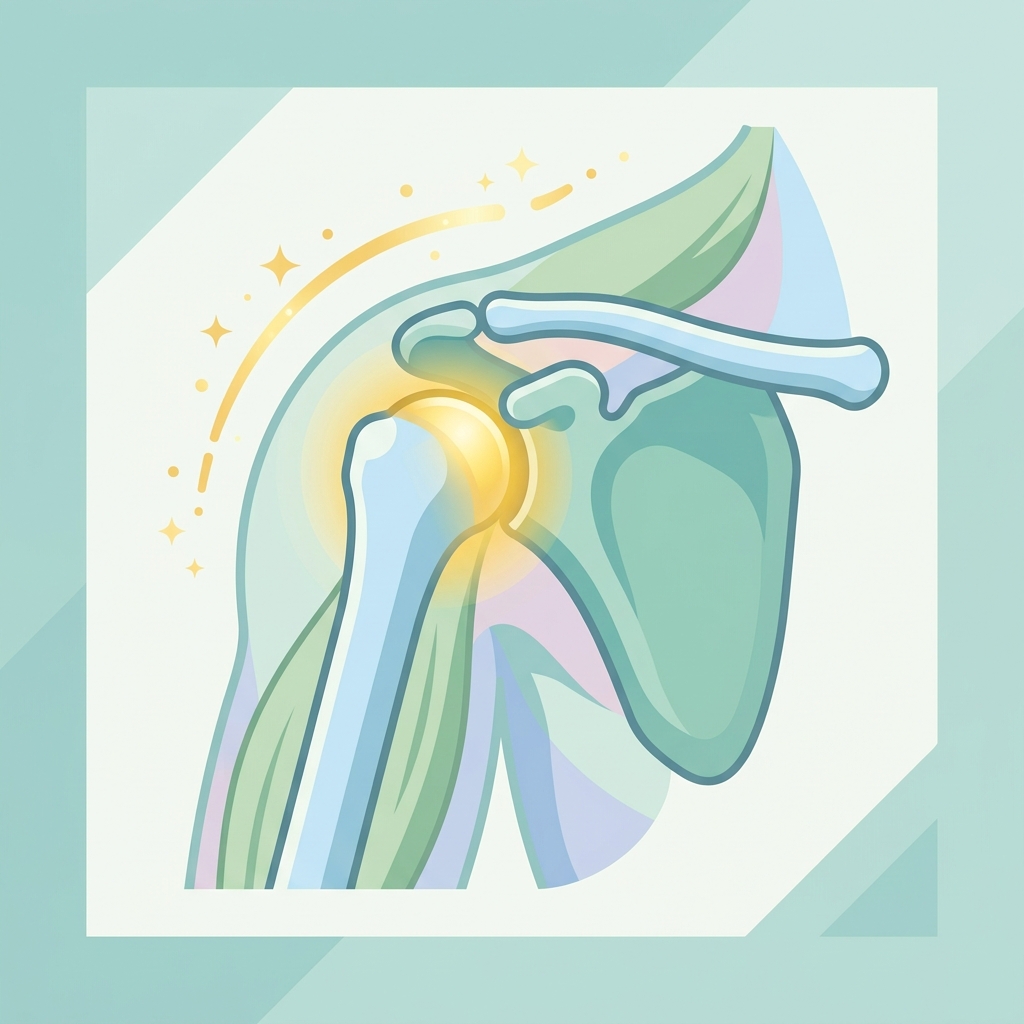
Proximal Humerus Fracture (Non-Operative) Protocol
A structured, phase-based rehabilitation protocol for non-operative proximal humerus fractures, outlining safe range of motion progression while in a sling.
A non-operative approach to a proximal humerus fracture is a highly effective treatment path for non-displaced or minimally displaced fractures. Because the shoulder is immobilized in a sling to allow the bone to heal, stiffness is a significant risk. The core philosophy of this rehabilitation protocol is to carefully balance fracture stability (allowing the bone to heal in the correct alignment) with progressive mobility (starting passive and active-assisted range of motion at precise timepoints) to prevent complications like malunion, non-union, or permanent joint stiffness.
Phase 1: Protection and Early Motion (Weeks 0-3)
Goals
- Protect the healing fracture and maintain correct alignment.
- Control pain, swelling, and inflammation.
- Prevent stiffness in the elbow, wrist, and hand.
- Maintain posture and cervical mobility.
Precautions & Restrictions
- Sling must be worn 24/7, including during sleep, except for hygiene and specific exercises.
- Strict non-weight bearing on the affected arm.
- No active shoulder elevation or active movement in any plane (no firing the shoulder muscles).
- No lifting, pulling, or pushing with the affected arm.
Suggested Exercises
- Active range of motion (ROM) for the elbow, wrist, hand, and fingers to prevent distal joint stiffness and swelling.
- Cervical spine range of motion (gentle neck tilts and rotations).
- Grip strengthening (e.g., squeezing a soft ball).
- Pendulum exercises (Codman's): If approved by the doctor, gently dangle the arm and sway it using body momentum (no active shoulder muscle movement).
Criteria to Progress
- Pain is manageable and decreasing.
- Compliance with sling wear.
- Physician clearance (X-rays showing stable fracture alignment without displacement).
Phase 2: Active-Assisted and Early Passive ROM (Weeks 3-6)
Goals
- Gradually initiate passive and active-assisted range of motion (PROM and AAROM).
- Protect the fracture site as the early soft callus forms.
- Re-educate scapular stabilizers.
Precautions & Restrictions
- Continue wearing the sling in public and during sleep.
- No active elevation/abduction of the shoulder against gravity.
- Limit external rotation (ER) to 30 degrees to prevent stress on the healing tuberosities.
- No lifting or carrying weight with the affected arm.
Suggested Exercises
- Passive range of motion (PROM) for shoulder flexion and abduction (performed by a physical therapist).
- Active-assisted range of motion (AAROM) using a wand, cane, or the opposite arm (forward flexion to 90-120 degrees, external rotation to 30 degrees).
- Scapular retraction and shrugs (shoulder blade squeezes and gentle lifts) to maintain healthy scapulohumeral rhythm.
- Pulley exercises for flexion and abduction within pain-free ranges.
Criteria to Progress
- Week 6 post-injury achieved.
- X-rays showing progressive bone healing (callus formation).
- Symmetrical passive and active-assisted range of motion within the targeted limits (flexion to at least 90-120 degrees).
Phase 3: Active ROM & Initial Strengthening (Weeks 6-12)
Goals
- Discontinue sling wear and transition to normal arm use for light daily activities.
- Restore full active range of motion (AROM) in all planes.
- Initiate light rotator cuff and scapular strengthening.
- Correct scapulohumeral rhythm.
Precautions & Restrictions
- Avoid sudden jerking movements or heavy lifting.
- No lifting objects heavier than 5-10 pounds.
- Exercises should remain pain-free; stop if sharp pain occurs.
Suggested Exercises
- Active shoulder range of motion (AROM) in all planes: forward flexion, abduction, external/internal rotation (e.g., wall climbs, active slides).
- Rotator cuff strengthening: isometric exercises in flexion, abduction, and rotation (pressing arm against wall without moving).
- Progressive theraband strengthening (light resistance) for internal and external rotation.
- Scapular strengthening: rows, scapular punches, and prone scapular stabilization (Y, W, T exercises).
Criteria to Progress
- Symmetrical or near-symmetrical active range of motion.
- Minimal to no pain with light daily activities.
- Safe execution of basic rotator cuff strengthening.
Phase 4: Advanced Strengthening & Functional Return (Weeks 12+)
Goals
- Restore full muscular strength, power, and endurance.
- Return to sports, heavy lifting, or physically demanding work.
- Address any remaining range of motion or functional limitations.
Precautions & Restrictions
- None, but progress loading gradually.
- Monitor for any recurrence of pain or impingement symptoms.
Suggested Exercises
- Progressive resistance exercises (using free weights or cables) for the rotator cuff, deltoid, and scapular stabilizers.
- Dynamic, multi-planar shoulder strengthening.
- Sport-specific or work-specific rehabilitation drills.
- Advanced functional training.
Criteria to Progress
- Return to full activity/sports without pain.
- Normal strength (at least 85-90% compared to the uninjured side).
These guidelines represent a standard rehabilitation protocol. Individual recovery rates vary significantly depending on the fracture severity, bone quality, and general patient health. Your treating physician may modify this protocol specifically for you.
Disclaimer: This protocol is for educational purposes and is not a substitute for professional medical advice. Always consult your surgeon or physical therapist before performing any exercises or modifying activity restrictions.

Related articles
Browse all articlesTrusted External Resources
Curated educational materials to help you make informed decisions about your orthopaedic bone & joint conditions.

Orthopaedia
Orthogate Patient Education