
Activity Modification for Shoulder Pain
Get Clear, Concise Answers to Your Top Questions About Activity Modification for Shoulder Pain
Q1. What is activity modification for shoulder pain?
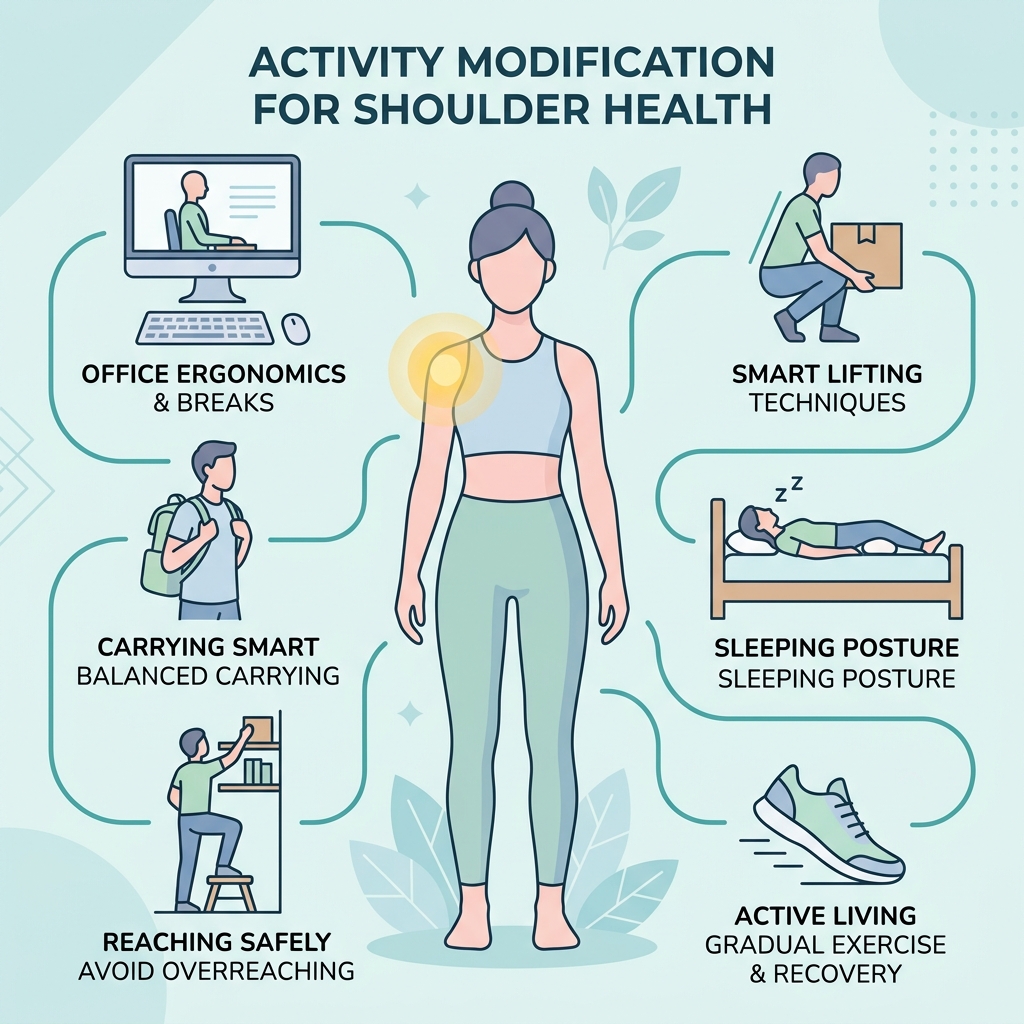
Activity modification is a treatment strategy where you temporarily or permanently change how you perform daily movements, work tasks, and recreational activities. Instead of completely stopping all physical movement, you adjust your techniques, body positioning, and the intensity of your activities. This helps reduce unnecessary stress on your injured shoulder tissues while keeping the rest of your body active and healthy.
Q2. Why is activity modification important for my shoulder recovery?
Repetitive strain and awkward angles can irritate shoulder tendons, ligaments, and joints, preventing them from healing. By modifying your activities, you give these tissues a rest and a chance to repair. Think of it as creating a safe environment for your shoulder to heal naturally, preventing minor irritation from turning into a chronic or more severe injury.
Q3. Does activity modification mean I have to stop all physical activity?
No, it does not. In fact, total inactivity can lead to shoulder stiffness, muscle weakness, and a condition called frozen shoulder. Activity modification is about finding safe alternatives. It encourages you to remain active by using pain-free ranges of motion, adjusting how you lift or carry items, and focusing on exercises that do not stress the shoulder.
Q4. How do I know which activities are causing my shoulder pain?
The easiest way is to pay close attention to when your pain occurs. Activities that involve reaching overhead, reaching behind your back, lifting heavy objects far from your body, or throwing are common triggers. Keep a simple daily journal to note which movements cause a pinch, ache, or sharp pain, and discuss these triggers with your healthcare provider.
Q5. What are some common daily activities that irritate shoulder pain?
Many everyday tasks can strain a vulnerable shoulder. These include:
- Reaching into high cabinets or shelves.
- Putting on a coat, jacket, or seatbelt.
- Carrying heavy grocery bags with an outstretched arm.
- Vacuuming or sweeping with large, repetitive strokes.
- Sleeping on the side of the painful shoulder.
Q6. How should I modify my sleeping position to avoid shoulder pain?
To protect your shoulder while sleeping, try these modifications:
- Avoid sleeping directly on your painful shoulder.
- If you sleep on your back, place a small pillow under your elbow and forearm on the painful side to support the shoulder joint.
- If you sleep on your opposite side, hug a thick pillow against your chest to support your painful arm and keep it from falling forward and pulling on the shoulder.
Q7. What is the correct way to lift objects to protect my shoulder?
When lifting objects, always keep them close to your body. Do not reach out with a straight arm to pick something up. Keep your elbows bent, hold your palms facing up, and use your legs and core muscles to help lift. Avoid lifting anything heavy above shoulder height; use a step stool or ask for assistance instead.
Q8. How can I modify work or computer setups to reduce shoulder strain?
If you work at a desk or computer, adjust your workstation to support your shoulders:
- Keep your keyboard and mouse close enough so your elbows are bent at a 90-degree angle and relaxed by your sides.
- Avoid reaching forward to type or use the mouse.
- Ensure your chair has armrests that support your forearms without pushing your shoulders up toward your ears.
- Take short breaks every 30 to 60 minutes to gently roll your shoulders and stretch your neck.
Q9. Can I still exercise or do sports if I have shoulder pain?
Yes, but you must modify your routine. Avoid exercises that put direct pressure on the shoulder joint, such as overhead presses, bench presses, lateral raises, and swimming strokes like the freestyle. Instead, focus on lower-body exercises (like walking, cycling, or leg presses) and core workouts. For upper-body strength, perform light movements where your elbows stay below shoulder height.
Q10. How do I distinguish between "good pain" (muscle fatigue) and "bad pain" (joint irritation)?
Differentiating these sensations is key to safe modification:
- "Good pain" feels like a dull, temporary ache or burn in the muscles. It usually goes away shortly after you stop exercising and improves within a day or two.
- "Bad pain" is sharp, stabbing, or pinching. It often occurs during a specific movement, lingers long after you stop, and may cause throbbing or burning at night. If you feel bad pain, stop the activity immediately.
Q11. What are some safe alternative exercises I can perform?
You can stay fit with several shoulder-friendly activities:
- Cardiovascular exercises like walking, hiking, riding a stationary bike, or using a recumbent stepper.
- Light resistance training using bands or dumbbells for your biceps, triceps, and wrists, keeping your elbows bent and close to your body.
- Core exercises like planks (modified on your knees or forearms if comfortable) or bridge exercises.
Q12. How long do I need to follow these activity modifications?
The duration depends on the cause and severity of your shoulder pain. For mild strains, a few weeks of modification may be enough to resolve the issue. For chronic conditions like rotator cuff tendinitis or arthritis, you may need to adopt some of these changes as long-term habits to prevent flare-ups. Always consult your doctor or physical therapist for a personalized timeline.
Q13. Can activity modification alone cure my shoulder pain?
Activity modification is a critical foundation for healing, but it is often combined with other non-surgical treatments. These may include physical therapy to strengthen supporting muscles, ice or heat therapy, over-the-counter anti-inflammatory medications, or cortisone injections. Together, these treatments provide the best chance for complete recovery.
Q14. What should I do if my shoulder pain does not improve with activity modification?
If your pain does not improve after a few weeks of consistent activity modification, or if it becomes worse, you should contact your doctor. They may recommend diagnostic tests, such as an X-ray or MRI, to look closer at the shoulder structures and discuss other treatment options, such as guided physical therapy or a surgical consultation.
Q15. How do I safely transition back to my normal activities?
Transition back slowly and gradually. Once you have been pain-free during daily activities for several weeks, gradually reintroduce your normal movements. Start with very light weights, shorter durations, or lower intensities. Increase your activity level by no more than 10% to 15% each week, and stop immediately if any of your original shoulder pain returns.
We encourage you to write down any specific questions you have and discuss them thoroughly with your surgeon, doctor, or physical therapist. They are your best resource for personalized advice and care.
Disclaimer: This brochure provides general information and is not a substitute for professional medical advice. Always consult your doctor or qualified healthcare provider with any questions you may have regarding your specific medical condition and treatment plan.

Related articles
Browse all articlesTrusted External Resources
Curated educational materials to help you make informed decisions about your orthopaedic bone & joint conditions.

Orthopaedia

Orthogate Patient Education