
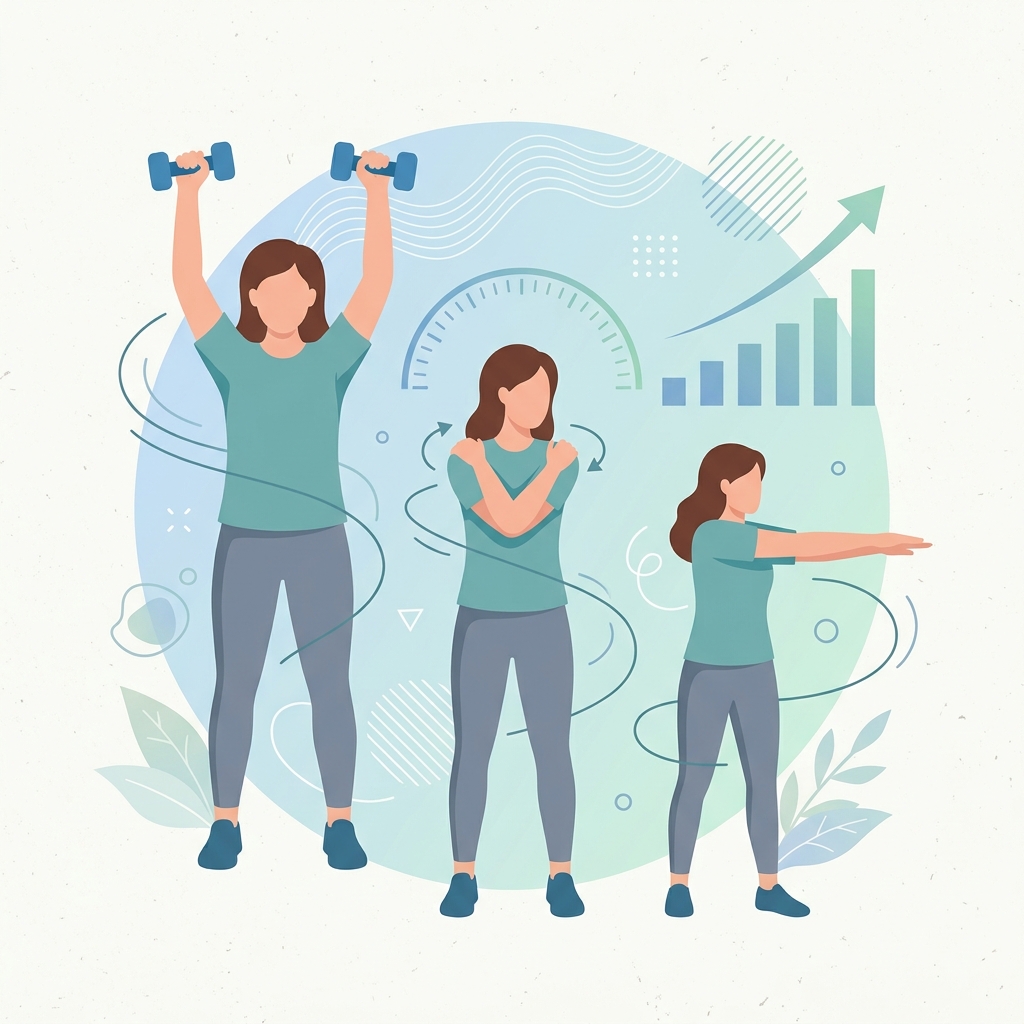
Autoregulatory Progressive Resistance Exercise (APRE) Exercises
Step-by-step home exercise guide for Autoregulatory Progressive Resistance Exercise (APRE) to safely progress shoulder rehabilitation using subjective feedback.
Autoregulatory Progressive Resistance Exercise (APRE) is an advanced, evidence-based method designed to help you safely progress your rehabilitation by adjusting your daily exercise intensity and volume. Instead of following a rigid, pre-determined weight or repetition schedule, APRE uses your subjective daily pain, fatigue, and performance to dictate how much load you should lift. This personalized, flexible approach ensures you challenge your muscles enough to stimulate recovery and strengthening when feeling great, while automatically protecting your healing shoulder joint on days when fatigue or discomfort is higher.
The APRE Autoregulation System
To implement APRE at home, you will monitor two key markers before and during each exercise: subjective pain (on a 0–10 scale) and fatigue/readiness. Use the following simple rules to adjust your resistance (band thickness or weight) for each exercise session:
- Green Light (Feel Great): Pain is 0-2/10, fatigue is low, and movement feels smooth and strong. Increase your resistance by one small level (e.g., move to the next band color or add 1-2 lbs) for your final working sets.
- Yellow Light (Proceed with Caution): Pain is a manageable 3/10 (dull ache only), or fatigue is moderate. Maintain your baseline resistance and focus on perfect execution. Do not increase weight or repetitions.
- Red Light (Stop and Adjust): Pain exceeds 3/10, is sharp, or you experience a sudden drop in strength. Decrease your resistance immediately by 50%, or stop the exercise for the day to prevent micro-trauma.
General Guidelines & Safety Precautions
- Warm-Up: Perform 5 minutes of gentle, active arm swings and shoulder rolls before starting.
- The Pain Rule: Discontinue any exercise immediately if you experience sharp, pinching, or catching pain in the joint. Only mild, muscular soreness is acceptable.
- Pacing: Perform each repetition slowly, taking 2-3 seconds for both the lifting and lowering phases.
Exercise 1: APRE Resistance Band External Rotation
Purpose: Strengthens the rotator cuff (infraspinatus and teres minor) to stabilize the humeral head in the socket, utilizing daily feedback to adjust band tension.
Equipment Needed: A resistance band anchored at waist height.
Starting Position: Stand tall with your side to the band anchor point. Hold the band with the outer hand, elbow bent to 90 degrees, and keep your elbow tucked close to your side (place a small rolled towel under your arm to assist posture).
Step-by-Step Instructions:
- Squeeze your shoulder blade slightly down and back.
- Slowly rotate your forearm outward, away from your stomach, keeping your elbow tucked.
- Pause for 1 second at the end of the movement.
- Slowly return to the starting position under control.
Dosage/Parameters: Perform 3 sets of 10-12 repetitions. Frequency: 3-4 times per week.
Tips/Common Mistakes to Avoid: Avoid shrugging the shoulder or rotating your entire torso to move the band. Keep the motion isolated to the shoulder joint.
Exercise 2: APRE Dumbbell Scaption
Purpose: Rebuilds strength in the supraspinatus muscle and anterior deltoid along the natural \"scapular plane\" of the shoulder, adapting weight based on daily discomfort.
Equipment Needed: A pair of light dumbbells (1 to 5 lbs) or household items (water bottles).
Starting Position: Stand with feet shoulder-width apart, holding weights at your sides, palms facing slightly forward (thumbs pointing up at a 45-degree angle).
Step-by-Step Instructions:
- Engage your core and slide your shoulder blades slightly downward.
- Raise both arms upward and outward at a 30 to 45-degree angle (forming a 'V' shape).
- Lift only to shoulder height (90 degrees). Do not force the arms overhead if painful.
- Slowly lower the weights back to the starting position.
Dosage/Parameters: Perform 3 sets of 10 repetitions. Frequency: 3 times per week.
Tips/Common Mistakes to Avoid: Avoid swinging the body or arching the low back. Do not point thumbs downward, as this can pinch the rotator cuff under the acromion.
Exercise 3: APRE Scapular Wall Press
Purpose: Re-educates the serratus anterior and lower trapezius muscles to support the shoulder blade, adjusting push intensity based on muscle fatigue.
Equipment Needed: A flat wall.
Starting Position: Stand facing a wall, place your forearms flat against it, elbows bent to 90 degrees, and forearms parallel to each other.
Step-by-Step Instructions:
- Press your forearms into the wall to push your chest away from the wall (spreading your shoulder blades).
- Slowly slide your forearms upward along the wall in a 'V' shape.
- Slide up only as far as you can maintain forearm contact and control, without shoulder shrugging.
- Slowly slide back down to the starting position, keeping constant pressure against the wall.
Dosage/Parameters: Perform 3 sets of 8-10 repetitions. Frequency: 3-4 times per week.
Tips/Common Mistakes to Avoid: Avoid shrugging your shoulders toward your ears as your arms slide up. Keep your neck relaxed throughout.
Always consult with your physical therapist or doctor before starting a new exercise routine. If any exercise causes persistent pain or swelling, discontinue it and contact your healthcare provider.
Disclaimer: This guide provides general exercise instructions and is not a substitute for professional medical advice. Always consult your doctor or qualified healthcare provider with any questions you may have regarding your specific medical condition and treatment plan.

Related articles
Browse all articlesTrusted External Resources
Curated educational materials to help you make informed decisions about your orthopaedic bone & joint conditions.
Orthopaedia

Orthogate Patient Education